A sake drinker Ichibay reports events that occur in his daily life and coveys his casually conceived ideas, focusing especially on sake and sake-related items and events. He sometimes writes about his short trips in his country Japan or provides some Japanese cultural stuff related to kimono, local performing arts, etc.
In the side yard of my house, there is a loquat tree. No one planted
this tree. It seems to have come out from a seed, and have grown up. Now, it
produces a lot of loquat fruits in June every year. My family enjoy eating
these fruits. However, the tree is too bountiful for us to consume all the
fruits and we usually left quit a lot on the branches and let birds to peck
them.
This year, I picked these fruits and made loquat liqueur.
The following is how I made the loquat liqueur:
Ingredients
Loquats 500 g
Lemons 2
Crystal sugar 50 g
Distilled spirit (shochu) 900 ml
1. Put the loquats, lemons, and sugar in a disinfected preserve jar,
and then add the distilled spirit.
2. Store it avoiding direct sunlight and high temperature.
After three months of aging, the loquat liqueur will be ready to be
drunk.
On May 5, an annual shishimai
event was held at Yakumo Shrine in Kawai district of Okutama Town, Tokyo. Yakumo
Shrine is in a distance of 10-minute walk from JR Kawai Station. I invited some
sake-drinking friends to join me to see this event. The style of the lion
dances dedicated to this shrine is the one called sambiki-shishimai or sasara-shishimai,
which is popular in various districts in the Kanto area including Okutama,
Chichibu, Ome, Akiruno, and other cities, towns, and villages.
The front approach way to the shrine consists of two flights of stone
stairs. If you look upward from the base of the first flight, you will find a "two-story
gate" in the dimness of the cedar tree grove. The approach goes through
under the gate leading to an open square beyond it. This "two-story gate,"
designated as a tangible folklore cultural property of Tokyo, has a unique
structure; standing on the mountain slope, the front appears to be a two-story
building while the back looks like a one-story building.
The upper floor of the gate on the back side serves as a stage for
plays, dances, and other local performing arts. However the three-lion dances
are not performed on this stage but in the open square in front of the stage.
The front approach leads to this center square, across which there is another
flight of stone stairs. At the upper end of these stairs is the front shrine.
Another noteworthy point of this Yakumo Shrine is that there are
several stone-walled tiers on both sides of the second flight of stairs. These
tiers serve as spectators’ seats so that visitors at this shrine can enjoy
watching a play, dance, or any other performance art performed on the stage or
in the center square.
High-standing cedar trees surrounding the spectators’ seats, center
square, and theater provide good shade for performers and spectators, and usher
a comfortable energy flow into the precincts, producing a sacred atmosphere of
a realm protected by some mysterious power.
On this day, we occupied our place on the third tier from the bottom
on the right, viewed from the stage. We had brought some bottles of sake, wine,
and snacks, and set them ready in place, waiting for lion dances to begin.
In these shishimai events,
seven performances of lion dances are performed. When we arrived at the place, it
was past noon, three performances had already been performed, and performers
were taking a lunch break. In the afternoon, still another four performances were
awaited.
Here, I would like to explain sambiki-shishimai.
This type of lion dances is danced by three dancers and some backup dancers with
music played by bamboo flutes.
The dancers wear headgear
called shishigashira. They are what the
Japanese in olden days thought look like lion heads (since the Japanese did not
know what the lion looked like exactly, they never look like lion heads, having
horns and feathers on the head). The dancers bear drums tied around their waists,
and beat these drums while dancing.
The backup dancers are
four, six, or eight kimono-clad people. The number of these backup dancers
varies according to the place where dances have been handed down. They play
instruments made by bamboo, making frictional sounds along with the melody of
bamboo flutes.
Many documents describing the derivation of lion dances are handed
down in many places in Japan, and according to these old documents, lion dances
have been started in 1245. The story is as follows:
In the spring of 1245, in the ceremonial hall Shishinden in the
imperial palace, imperial families and their guest were enjoying a party.
Suddenly, the sky turned dark and they heard thunders and saw streaks of
lightning. Then, three shining objects appeared in the sky and they flew to
these people, finally fell with thuds in the garden of the Shishinden. These objects
were something they had never seen before, and they were surprised and scared.
Then, after close observation of these objects, the people knew these objects looked
like three heads of some animal. No one knew what in the world these things
were. The emperor had a fortune-teller see these things to see whether they
were a good omen or bad. The fortune-teller said, "these are the head of
lions living in India, and they are great auspices," continuing, "if people
wear these on their heads and dance, our country stays in peace forever." In
this way, people started these lion dances. Of course, this is a legend, and no
one take this story at face value.
By the way, I often come to enjoy the lion dances of this Yakumo
Shrine, and every time I am at this event, one clown guy first dancing with other
dancers but later coming out from the dance place bears a bottle of sake, comes
to us, and offers sake to us. This is my most favorite point of these lion
dances at Yakumo Shirine.
This
year, it quickly gets warmer and warmer after the arrival of March. It even
seems to me that Japan is skipping spring and just directly jumping from winter
into summer. All the cherry trees across the country are hasting to bloom. The
cherry tree in the garden of my house also started blooming. So, the day before
yesterday (March 20), I went out to the Hamura Diversion Weir to check how the
cherry trees there are blooming.
(Filmed on March 20,2013)
The trees
had just started blooming, but I know they will quickly reach their culmination
and then turn into foliage. Probably, we will be able to see the trees in full
bloom at the next weekend and we could enjoy blossoms quite much even this
weekend.
Hamura City, where the Hamura Diversion Weir is located,
holds "はむら花と水のまつり (Hamura Flower and
Water Festival)" in this time of the year (from March 27 to April 15 for
this year). The festival is originally seemed to have been planned so that you
could enjoy cherry blossom around the weir in the first half of the festival period,
and tulip flowers planted in the rice paddy fields located upstream from the weir
in the last half.
For cherry blossom viewing, for this year, I guess you
should come to Hamura in March. It may be too late to come on the first weekend
of April.
The city will hold some festival events on the second weekend
of April, including Dashi no Hikiawase
(they compete with one another in how well they play their bamboo flutes and
drums on their festival floats) on 13th and Mikoshi
no Kawaire (they carry the portable shrine and go into the Tama river) on
14th although I think it will be too late for also enjoying cherry blossom
viewing at this time.
(Dashi no Hikikawase last year: Filmed on April 7, 2012 at JR Hamura Station)
If unfortunately
you cannot make it by the right time of cherry blossom viewing, you will still
be able to go upstream to see tulip flowers (tulip flowers can be see until the
middle of April).
Cherry blossoms filmed on April 10 last year (on the bank upstream
the Hamura Diversion Weir). The cherry blossoms come into bloom far earlier
than usual.
(Cherry blossoms upstream of the weir: Filmed on April 10, 2012)
If you
prefer bustling atmosphere of the festival, I recommend you to walk around the
Hamura Bridge; there are food and drink stands here and there, monkey show, and
even footbath service using hot spring water brought from distant onsen places. If you are a person who
loves a quieter environment, you can walk upstream to the bank along the river,
where cherry trees are planted and you can admire blossoms sitting under a tree
in a relaxing mood.
There is a big shrine
called Okunitama Shrine in Fuchu City, Tokyo. On New Year’s Day, a lot of
people visit the shrine to offer prayers, and commercial business people set up
their food stands along the approach way to the shrine building to provide
these visitors with food and drink services. On a festival day of a specific
shrine or temple, you can often see its approach way flanked by food and drink
stands selling ringo-ame (candy-coated
apples), tako-yaki (octopus
dumplings), yakisoba (pan-fried
noodles), and even tornado potato and doner
kabab. There are also those who are selling shellfishes such as turban
shells and scallops grilled on charcoal fire. This seems to be a nice place for
those who want to drink during the daytime. So, having nothing to do in particular
during the New Year’s Holidays, I asked one of my drinking friends to come with
me to this place.
This was the first opportunity for
going out for drink this year, and I felt I could not wait to have nice grilled
seafood and sake, but I first gave my respects to the god. This Okunitama
Shrine is said to have been built in 111 A.D., during the period of the Twelfth
Emperor Keiko. The enshrined god is Okunitama-no-okami, also known as
Okuninushi-no-mikoto.
I stood facing the front shrine, threw
a coin into the offertory box, and gave prayers to the god, “please, let me
drink a lot of nice sake also in this year.” The enshrined god
Okuninushi-no-mikoto is worshiped as a god of nation building, agriculture,
commerce, medicine, etc. Will the god satisfy my desire, a quite earthly one?
Anyway, I finished what I had to do. Now,
I can drink to my heart’s content.
There are a lot of stands and
makeshift restaurants on both sides of the approach way, selling various foods
and drinks. Among them, there is an area above which a large sheet is set up to
serve as a roof. Under the sheet were tables and chairs, and various food and
drink stands such as takoyaki, yakisoba, and hamayaki (charcoal-grilled shellfish) stands. There are also sake,
beer, and other drinks. You can buy any food or drink at any stand, bring what
you bought to a table, and eat and drink them.
Sake sold there are Hakutsuru,
Sawanotsuru, etc., which are major brands and popularly drunk across the country.
I bought warmed cup sake of Hakutsuru and paired it with a grilled turban shell,
scallops, and oyster. I think shellfish tastes nice with sake. Yummy!
Okutama
Lake, nestled among mountains in Okutama Town, the western part of Tokyo, is an
artificial lake backed up by Ogochi Dam. The construction of the dam started in
1938, and was completed in 1957 after having been interrupted by the war for a period
of several years.
From
the Okutama Station to Ogochi Dam, you can take a bus, which drives along Japan
National Route 411. The road in this section goes along the mountain stream of
Tama River, passing through sporadic tunnels. This road is of course essential
for people living in this area, but before this road was constructed, they were
using an old road, which is now called Okutama Muakashi-michi (literally, old
road in Okutama).
Okutama
Mukashi-michi, an about 10-km community road, was made in 1899 to replace the
about 14-km mountain path connecting the Hikawa district and Ogochi district,
and this Okutama Mukashi-michi became a very important path for people in the
area. Along the path, there were shrines, temples, teahouses, water vessel for
horses bringing baggage or people, etc.
In
1945, the new road, which had been constructed earlier originally for
transporting material for the construction of Ogochi Dam, became open to the
public, and people became able to use this road for their living. Consequently,
the importance of Okutama Mukashi-michi reduced and people became to use the
new road more often than this old path.
Some
sections of the Okutama Mukashi-michi path are paved with asphalt, and we can
see cars and trucks go up and down in these sections. However, some sections
are very narrow paths, some sections consist of only a few flights of stairs,
and even some sections are mountain trails. There were guideposts at every key
location and it is easy for visitors to stay on the right track, and there are
benches to take rest and well-maintained public restrooms along the road. So,
anyone can enjoy a holiday walk at ease.
It
seemed there were many interesting spots to see, and I decided to go for a walk
along this road on a late autumn day.
(Start
point of the road)
With
some food and drink in a daypack, I started Okutama Station about 10:00 a.m.,
and soon reached the start point of Okutama Mukashi-michi. From the beginning,
I needed to walk up a steep asphalt-paved slope, called Haguro-zaka. Halfway on
the slope, I found a tori gate on the
right. There were stone stairs behind the tori
gate. The stairs had to lead to a shrine and I thought I should pay respects to
the god enshrined, so I started walking up the stairs, which was longer than I
expected. When I finished two flights of stairs, I was in a small open space,
and it turned out that the stairs I had been struggling up was just a part of
the long approach to the shrine, because I found across the open space a
guidepost indicating the way to the shrine. So, I gave up visiting the shrine
and went down the stairs back to the main route.
After
leaving the tori point, soon the
route entered a narrow path. Soon, this walkway began to run along a defunct railroad
track on the left. This track was used in the past to transport material for
the construction of the dam. I walked on the walkway along the railroad track
for a short while, and then the walkway curved rightward to leave the railroad
and then leftward to gradually climb up, reach the railroad track, and go over
the tunnel through which the track was further extending.
(Defunct
railroad track)
Then,
the narrow path connected to a wider asphalt-paved road, and soon I reached the
point where a well-maintained house of public facilities. Inside the house,
there is also a place for walking passengers to take a rest.
(Well-maintained
public restroom along the walkway)
The
walkway went through mountains and I walked admiring beautiful autumn leaves
here and there.
(Road
in mountains)
At
some points, I could see some part of that railroad track. In a small community
called Sakai, I found a railroad bridge above my way. The railroad seemed to
have been running almost parallel to the walkway, and I could see its remnants
while walking.
(Railroad
bridge)
The
walkway was generally very comfortable to walk, relatively even, not hard to
walk (just a short part in the beginning and about an-hour part in the last
were mountain trails).
After
leaving the Sakai community, I soon reached the Shirohige Shrine. In this small
shrine, a big rock is enshrined as the object of worship. In summer, sanbiki shishimai dances (a type of
local performing arts performed by three dancers with headgear resembling the
heads of lions, other dancers, and musical instrument players such as bamboo
flutists) are performed in the precincts of this shrine as offerings to the
god. I have seen their performance before, and it was very interesting.
(Stone
stairs leading to the Shirohige Shrine)
(The
tilted huge rock on the right of the shrine house is the object of worship.)
In
a few-minute walk distance from the shrine, I found a maple tree beautifully
decorated with red and yellow leaves. The colors of this tree seemed to be
brightening up things around this point.
(Iroha-kaede: Japanese maple)
The photo below shows a water vessel
for horses to drink. According to the description on the board, there were
three teahouses around here so that passengers can rest for a while. The
teahouses were selling snacks, udon
noodles, bean-paste buns, tobacco, etc. Guests could even drink cups of sake.
(Water vessel for horses to drink)
I had been walking for over three
hours since I started walking when it was around 1:30. I felt very hungry and I
had been looking for a nice place to have a rest and eat my lunch. And, I
finally found a perfect place for my lunch. The place was overlooking the
valley, and there were tables and benches surrounded by trees with yellow,
orange, red-colored leaves.
(Lunch place!)
After having the lunch, I started
walking again and soon the walkway left the asphalt-paved road and turned into
a trail in mountains. The walkway was most arduous in a section beginning from
this point. However, I like walking on a mountain trail while seeing beautiful
trees and leaves. I think this part was the most interesting for me.
(Point where the asphalt road ends and
the mountain trail starts)
(Trees with autumn leaves)
(I like walking on fallen leaves.)
At a point close to the end of this
walkway, there is a nice lookout platform beside a teahouse named Aome-fudoson
Rest Station. From the platform, I could overlook Okutama Lake. I enjoyed a
nice lake view.
(Guidepost indicating Aome-fudoson
Rest Station)
(Lake view from the lookout platform)
From here, I got to the Mizune bus
stop in 30 minutes or something to end my walk this day. It was fun to walk along
this old path while enjoying nice views of the valley, mountains, and autumn trees,
and giving more than a passing thought to life of people who lived in this area
in olden days.
Recently, I
bought an interesting sake product from the shop of Reijin Shuzo (麗人酒造) in Suwa, NaganoPrefecture.
This is called Matsutake-sake, a bottle of sake with matsutake mushrooms
in it. Matsutake is very popular and expensive mushroom and Japanese
people like matsutake so much that they import the mushroom from China, Canada, and other countries.
In the
bottle, there are cut matsutake. So, I thought, we could grill and eat the
mushroom while drinking this sake, and I called some friends to held a party.
Another theme
of the party was yudofu. Yudofu means boiled tofu. We place
pieces of tofu in hot water to warm up them, and enjoy tofu hot. To enjoy the original
taste of tofu at the maximum, we boil tofu just with a piece of kombu (kelp,
or Laminaria japonica), and no complex recipe is necessary. We dip the
warmed tofu in soy-based sauce and eat it.
And, to make
the party more attractive, this time I introduced a new device for yudofu,
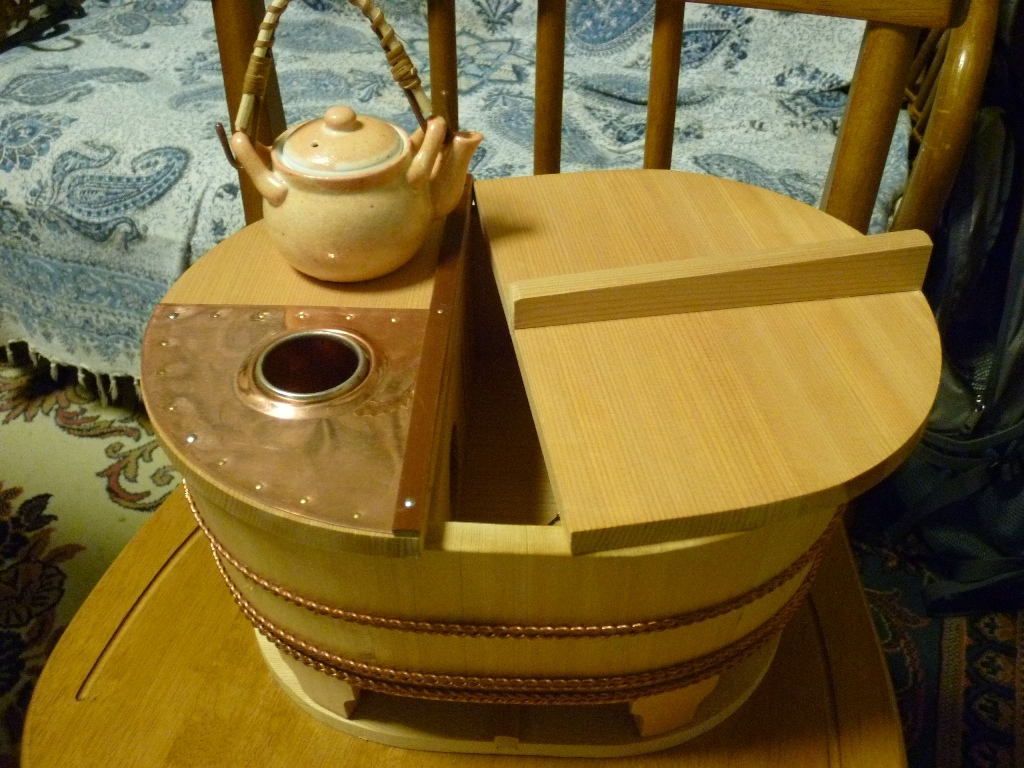
which is called yudofu-oke (wooden pail for making hot tofu). The pail
is made of sawara cypress and equipped with a brazier in which burning charcoal
is to be placed. When you put water in the pail and burning charcoal in the
brazier, the heat of the charcoal warms the water. So, you put cut tofu pieces in
the water to warm them up.
However, I
had some problems about the yudofu-oke. The opening of the brazier was
small and I can put only small pieces of charcoal in the brazier. Also, the
brazier itself is not very big to contain much charcoal. Maybe, yudofu should
not be eaten at so high a temperature, or I can preheat water with another pan
or kettle.
By the way, the
small pot with handle set on the yudofu-oke (see the picture below) is
for warming the sauce for yudofu. You just put some sauce in the pot and
set the pot on the yudofu-oke. However, if you love warmed sake, I think
you can put your sake in the pot and set it on the pail to warm it.
Well, what
about the matsutake sake? The sake was in a 1.8-litter bottle, and I had
some difficulty to take out the mushrooms. The mushrooms were first floating in
the upper part of the sake, but later they sank deep in the bottle. So we need
to empty the bottle first. We were five people, and some kindly brought 720-ml bottles
of sake. So, we had another three 720-ml bottles. After emptied these three
bottles, emptying another big bottle was hard for us. After all, I needed to
move some of the sake to an emptied small bottle.
The matsutake
sake has a slight smell of the matsutake mushrooms. The mushrooms, which
we grilled and ate, tasted alcoholic from being soaked in the sake for a long
time.
October 6,
the sake breweries of Maihime, Reijin, Honkin, Yokobue, and Masumi held a sake
drinking event called "Kamisuwa Kaido Aki no Nomiaruki" (autumn
sake-drinking walk along the Kamisuwa Kaido street). These five breweries are
located along Route 20, close to JR Kamisuwa Station.
Incidentally,
we were a six-people party and the five except me were women, with a high lady
rate of 83%. I don't have so many male acquaintances who love sake, and I think
I drink sake with women more often with men. As to my recent association, I
feel women drink sake more than men.
Well, I get
back to the original topic. Each of us first paid 2000 yen for a tag ticket and
a kikichoko, Hanging the ticket from the neck, we walked along the
street to visit the breweries. At each brewery, we could drink prepared sake as
much as we want using the given kikichoko. There were some food stands
from which we could buy some snacks to pair with sake.
We started walking
from the brewery closest to Kamisuwa Station, in the order of Maihime, Reijin,
and Honkin. Then, we skipped Yokobue (since the brewery was on the opposite
side of the street to the first three breweries) and went to Masumi. On the
return path toward the station, we visited the last brewery of Yokobue.
The
Miyama-nishiki version of Maihime Junmai Ginjo Suiro Namazazke (舞姫純米吟醸翠露生酒) had
a very mild taste, and I liked it. My companions liked the Bizen-omachi version
of this sake, but I feel my preference is leaning toward Miyama-nishiki.
At the Reijin
brewery's shop, they were selling special sake, Matsutake-zake (sake with mushrooms
loved by the Japanese in it) although this was not prepared for drinking in
this event. The bottle of this sake contains some Matsutake mushroom. I dropped
in this shop on my way home next day, and purchased a bottle of the sake. I
want to drink this sake warmed, while grilling the sake-steeped mushroom on
burning charcoal and eating it. The pairing of this sake and grilled mushroom
would be fine.