A sake drinker Ichibay reports events that occur in his daily life and coveys his casually conceived ideas, focusing especially on sake and sake-related items and events. He sometimes writes about his short trips in his country Japan or provides some Japanese cultural stuff related to kimono, local performing arts, etc.
Unlike my conventional Youtube channel ("いちべー動画チャネル"), this channel is specialized only in the kandouko sake warmer. Since the channel is intended for those who do not understand Japanese, I try to use the English language to explain the contents (narration, subtitles, and language spoken by me in video).
For now, the channel includes 9 uploaded video works, and other video works selected from the "いちべー動画チャネル."
The following is the newest contents as of June 28, 2018.
I hope everyone can enjoy my video and gets familiar with this intriguing device called "kandouko."
I am pleased to report readers of my blog that Nokanro, a commercialized
product that has the same functionality as that of what is called kandouko, which I several times wrote about
in past posts of this blog.
Sake lovers sometimes drink their sake warm. Actually, some types of sake
are very nice when they are warmed. However, to enjoy warmed sake, it is very
important that you warm your sake in a proper way to a proper temperature.
A microwave oven is a useful device for warming sake. However, it
tends to happen that sake is warmed unevenly; some part of the sake becomes hot,
and some part remains still cold.
An alternative to the microwave oven is to place a flask containing
sake in hot water and leave it until the sake becomes hot. You put some water
in the pan, place the pan on a gas stove, place the flask containing sake in
the water in the pan, and then wait for the sake to become warm.
Otherwise, you can use a dedicated sake warmer. There are various types
of sake warmer products. You can execute Google image search with the keywords
"sake warmer" to view different sake warmers. Some products use
electricity to warm sake, and some are designed to be used on a gas stove.
There are those that are just containers made of thermal material to contain
hot water; sake flasks are just placed in them and left until the sake becomes
warm.
Among these various sake warmer types, there is one that uses
charcoal fire. A sake warmer of this type is called kandouko (or nokanro).
The figure below shows the structure of the kandouko, which is a gadget usually made of copper, and is
basically a water tank with an embedded brazier. As shown in the figure, the
gadget holds some amount of water, warms the water with heat of charcoal fire burning
in the brazier. Since the kandouko is
not so large, you can use it on a table, where you drink sake.
You place a flask of sake in the heated water in the tank, to warm
your sake. While you wait for your sake to become warm, you can cook some foods
such as dried fish on the grill placed over the charcoal fire. So, the bottom
line is, amazingly, the kandouko serves
as not only a sake warmer but also a small tabletop cooker!
The microwave oven is handy, but you need to leave the table every
time you make a helping of sake. The same thing can be said to using a pan containing
water on a gas stove. Using a tabletop device like a kandouko eliminates the need to leave the table for helpings. Moreover,
cooking some foods on a kandouko adds
to pleasure of sake drinking.
The kandouko is not so large and heavy, so you can bring it to a deck
or porch, or outdoors. You can enjoy sake with the kandouko when you go out for camping, fishing, or just relaxing in
the nature.
Having read the above, if you are a great sake fan, you may have become
wanting to own a kandouko. Kandoukos
are sold in antique shops or in net auctions, and I have actually purchased
some of them in net auctions. I think it was difficult for people living
outside Japan to purchase one (these items are usually not exported). However,
a new company named Jipang Works has lately been established and started
selling a product named "Nokanro,"the very revival of kandouko.
The following is the link of the site of this product.
Before this product appeared in the market, brand-new kandoukos were hardly sold (I know there
was one shop selling brand-new kandoukos
but the price was far from affordable), and the only practical choice to own a kandouko was to make a successful bid in
a net auction or find and buy one in an antique shop.
Now that Jipang Works started selling its Nokanro, it has become
easier to own a kandouko because you
can buy the Nokanro. The Nokanro is sold at a price of 31,000 yen (including 8%
consumption tax). The product includes the main unit, a net grill, a lid for
extinguishing charcoal fire, and a fire grate to be placed in the brazier.
If you live in Japan and you buy a kandouko in a net auction, you will pay 5,000 to 20 thousand yen or
more for it. So, an antique item is still less expensive than a brand-new
Nokanro, However, the new Nokanro looks beautiful and robust.
Lately, sake is gaining in popularity in markets outside Japan. Sake
is a beverage that can be enjoyed at various temperatures, and some of the sake
fans in foreign countries have noticed this fact and have found pleasure in
drinking their sake cold, at a room temperature, lukewarm, warm, or hot, as
they like. The more people recognize diverse pleasure of sake, the more people may
want to enjoy sake in various ways and styles, including by using a gadget like
the Nokanro. So, there must be a growing market of sake warmer like the
Nokanro. Actually, when I posted a blog article about the kandouko before, a reader of my blog, inspired by my post, created
a handmade kandouko and he wrote about
his kandouko in his blog post. Very
interesting. I think there must be some people overseas who are willing to buy
a Nokanro, and I hope this Nokanro will sell well among not only people in
Japan but also those outside the country.
The kandouko sake warmer is
thought to have been used since the early Edo period in Japan. Apparently, people
in those days brought these gadgets with them for outdoor activities such as
cherry blossom viewing, and there they use them to enjoy warmed sake outdoors.
Several years ago, I found out about the kandouko sake warmer when I saw its advertisement on a Web page. It
seemed that a sake-brewing-related company named Daikokuya had reproduced this old
device from the Edo period and they were selling this gadget. Actually, it seemed
to me a fascinating device, but too expensive to afford for me (it was priced
at 126,000 yen).
The picture below shows the structure of the kandouko. The kandouko
holds some amount of water in it, warms the water with heat of charcoal fire
also burning inside this gadget, and warms sake with the warmed water. While you
wait for your sake being warmed, you can cook some foods such as dried fish on
the grill placed over the charcoal fire.
One of the problems when you enjoy warmed sake is that, when you
finish the current helping, you need to leave the table for preparing another
helping in the microwave etc. and your merry drinking time is interrupted by such
work. I think the kandouko is a perfect
solution to this problem, and moreover it even offers a bonus function for
grilling some foods.
I was dying to own one of these gadgets, and so went on the Web to a
net-auction site to see whether someone was selling one. There were some of
these devices being sold. After one or two trials of bidding, I could finally
purchase one. It cost around 6,000 yen. A good deal!
From then on, I often enjoy warmed sake with this kandouko. Also, I sometimes go
net-shopping for those devices, and now I own five of them.
I treasure these gadgets so much that I made a song of kandouko. I make a movie of the kandouko using this song as BGM and
uploaded it on the Youtube site. Please enjoy my movie, in which I sing the Song
of Kandouko Sake Warmer, and it shows you how I enjoy warmed sake with my kandouko.
On January 2 of this year, I paid a visit to the Imperial Palace to celebrate
New Year for the Emperor and other imperial families.
This was my first experience to enter the premises of the Imperial
Palace, and I was impressed to see so many people with the same intention as
mine gathering in the square in front of the palace (a total of over 80 thousand
people paid a visit the Imperial Palace on this day).
Being one among those tens of thousands of visitors, I was waiting
for the appearance of His Imperial Majesty and other imperial families. At around
11 o'clock, as soon as they appeared on the deck, the visitors started waving
Japanese national flags and praising aloud His Imperial Majesty, wishing him
health and longevity. Then, His Majesty and families responded by waving us.
At this time, I felt that all the visitors in that place were
spiritually bound with each other as subjects of His Majesty, and realized that
the Emperor makes our nation what it is now. Maybe, Japanese are unaware why
Japan is what it is now, that Japan is what it is now because of His Majesty. Then,
a thought came to me that whenever facing hardship, we can work as one to
overcome it because of the fact that we have His Majesty.
Finally, let me add this: one of the greatest things about our Emperor
is that the Emperor of Japan boasts the world's longest history of bloodline. Our
Emperor is the 125'th generation of the bloodline that started from the first
Emperor Jinmu.
I believe that the practice of enjoying warmed sake constitutes one
of the most important parts of the sake culture.
I myself often enjoy warmed sake, and I usually use a kandouko (see "Finally got akandouko (sake warmer)!") to prepare warmed sake. However, if you want to sip
sake in a hot bath, I can show you an easy way to prepare warmed sake. This
method recently flashed on me. Prepare cup sake and use the following procedure.
1. Leave the cup sake in the bathtub in which hot water is filled.
2. Wait for a while until your warm sake becomes warm enough.
3. Bathe in the bathtub and enjoy warmed sake at the same time.
Usually, the bathtub in a Japanese house is connected with a boiler,
which can be used to keep the water in the tub warm. So, you can stay bathing
in warm bathtub long enough for having relaxing time over sips of warmed sake.
Japanese people have a practice of taking a bath in a special way on
the day of the winter solstice. They put some yuzu orange fruits in the bathtub and then bathe.
It is said that taking a yuzu
bath helps prevent you from catching a cold. The rind of the fruit contains ingredients
that are effective in blood circulation promotion and maintaining beautiful
skin. Of course, the aroma of the yuzu
fruit relaxes you. Then, there is no reason for me to take a yuzu bath.
Lately, we have quite cool autumn days here in Japan, and I have more
chances to enjoy warmed sake than I did in summer time of course.
I chiefly use a kandouko
for warming my sake. This is a copper-made gadget for warming sake. The kandouko holds some amount of water within
it, and it has built-in brazier in which burning charcoal is placed. The heat
from the charcoal warms the water and the warmed water in turn warms sake in a
flask, tokkuri, chirori or whatever container placed in the water. While warming
sake, you can also cook some foods such as dried fish on the grill placed over
the charcoal fire.
So, with the kandouko, you
can cook some food while drinking warm sake, and this is my favorite point
about the kandouko.
Today, I'd like to introduce two easy canned food recipes using the kandouko.
Enoki-Saba-Misoni (Enokitake
mushrooms and Saba mackerel boiled
with miso-paste soup)
Ingredients:
One can of Saba-Misoni, 100 g of Enokitake, shredded cheese.
How to cook:
1. Make a small "pan" from aluminum foil, and place it on
the brazier.
2. Place Saba-Misoni and Enokitake on the "pan." Adjust the
amount of these ingredients so that they can be contained in the "pan."
3. Wait until the ingredients are boiled, then put some shredded cheese
on them.
4. When the cheese is melted, the food is ready.
The food was a little bit salty from the miso-based soup, so you may
want to add some vegetable, such as shredded cabbage, green pepper, etc.
I uploaded a video work demonstrating how to cook this. Then, I got a
message from some one, recommending the following recipe:
Saba Flavored with Mayonnaise
(boiled Saba
mackerel flavored with mayonnaise)
This menu is also easy to prepare. Because I want to prepare food
while preparing warm sake, my kandouko
cooking menu must be cooked only on the small brazier of the kandouko and must be easy to prepare.
Ingredients:
One can of Saba Mizuni (plainly boiled Saba mackerel), mayonnaise, ground pepper, soy sauce, and green
onion (green part)
How to cook:
1. Open the can of Saba Mizuni, and place the can on the brazier.
2. When the contents of the can are boiled, add mayonnaise, ground
pepper, and soy sauce.
3. Then, add chopped green onion.
4. Crumble the blocks of Saba mackerel and mix the ingredients
together.
I am not sure about the amount of each ingredient but if you use too
much of each ingredient, they may overflow from the can. Maybe, you may want to
use a small pan instead of just directly put the can on the brazier.
It is September now, and it is a special season for sake lovers, the
season of hiyaoroshi.
Hiyaoroshi is a type of the sake that is
pasteurized after being pressed in winter or early spring, then aged in a cool
storage house until summer is over, and then bottled without undergoing the
process of second-time pasteurization (many sake products are pasteurized
twice).
Many of the breweries in Tokyo are now shipping their hiyaoroshi products. So, I called the
liquor shop I patronize to bring me two bottle of hiyaoroshi. They are Kasen Tokubetsu Honjozo Hiyaoroshi and Sawanoi
Hiyaoroshi.
We still have some hot summery days between series of autumnal fresh days,
but regardless of its being hot or cool, I'm enjoying autumn flavor.
The owner of the liquor shop, when bringing me these bottles, told me
that the Sawanoi Hiyaoroshi of this year was especially good and recommended me
to have it lukewarm. Probably, my sake warmer kandouko will be busy from this September until next spring.
In the side yard of my house, there is a loquat tree. No one planted
this tree. It seems to have come out from a seed, and have grown up. Now, it
produces a lot of loquat fruits in June every year. My family enjoy eating
these fruits. However, the tree is too bountiful for us to consume all the
fruits and we usually left quit a lot on the branches and let birds to peck
them.
This year, I picked these fruits and made loquat liqueur.
The following is how I made the loquat liqueur:
Ingredients
Loquats 500 g
Lemons 2
Crystal sugar 50 g
Distilled spirit (shochu) 900 ml
1. Put the loquats, lemons, and sugar in a disinfected preserve jar,
and then add the distilled spirit.
2. Store it avoiding direct sunlight and high temperature.
After three months of aging, the loquat liqueur will be ready to be
drunk.
On May 5, an annual shishimai
event was held at Yakumo Shrine in Kawai district of Okutama Town, Tokyo. Yakumo
Shrine is in a distance of 10-minute walk from JR Kawai Station. I invited some
sake-drinking friends to join me to see this event. The style of the lion
dances dedicated to this shrine is the one called sambiki-shishimai or sasara-shishimai,
which is popular in various districts in the Kanto area including Okutama,
Chichibu, Ome, Akiruno, and other cities, towns, and villages.
The front approach way to the shrine consists of two flights of stone
stairs. If you look upward from the base of the first flight, you will find a "two-story
gate" in the dimness of the cedar tree grove. The approach goes through
under the gate leading to an open square beyond it. This "two-story gate,"
designated as a tangible folklore cultural property of Tokyo, has a unique
structure; standing on the mountain slope, the front appears to be a two-story
building while the back looks like a one-story building.
The upper floor of the gate on the back side serves as a stage for
plays, dances, and other local performing arts. However the three-lion dances
are not performed on this stage but in the open square in front of the stage.
The front approach leads to this center square, across which there is another
flight of stone stairs. At the upper end of these stairs is the front shrine.
Another noteworthy point of this Yakumo Shrine is that there are
several stone-walled tiers on both sides of the second flight of stairs. These
tiers serve as spectators’ seats so that visitors at this shrine can enjoy
watching a play, dance, or any other performance art performed on the stage or
in the center square.
High-standing cedar trees surrounding the spectators’ seats, center
square, and theater provide good shade for performers and spectators, and usher
a comfortable energy flow into the precincts, producing a sacred atmosphere of
a realm protected by some mysterious power.
On this day, we occupied our place on the third tier from the bottom
on the right, viewed from the stage. We had brought some bottles of sake, wine,
and snacks, and set them ready in place, waiting for lion dances to begin.
In these shishimai events,
seven performances of lion dances are performed. When we arrived at the place, it
was past noon, three performances had already been performed, and performers
were taking a lunch break. In the afternoon, still another four performances were
awaited.
Here, I would like to explain sambiki-shishimai.
This type of lion dances is danced by three dancers and some backup dancers with
music played by bamboo flutes.
The dancers wear headgear
called shishigashira. They are what the
Japanese in olden days thought look like lion heads (since the Japanese did not
know what the lion looked like exactly, they never look like lion heads, having
horns and feathers on the head). The dancers bear drums tied around their waists,
and beat these drums while dancing.
The backup dancers are
four, six, or eight kimono-clad people. The number of these backup dancers
varies according to the place where dances have been handed down. They play
instruments made by bamboo, making frictional sounds along with the melody of
bamboo flutes.
Many documents describing the derivation of lion dances are handed
down in many places in Japan, and according to these old documents, lion dances
have been started in 1245. The story is as follows:
In the spring of 1245, in the ceremonial hall Shishinden in the
imperial palace, imperial families and their guest were enjoying a party.
Suddenly, the sky turned dark and they heard thunders and saw streaks of
lightning. Then, three shining objects appeared in the sky and they flew to
these people, finally fell with thuds in the garden of the Shishinden. These objects
were something they had never seen before, and they were surprised and scared.
Then, after close observation of these objects, the people knew these objects looked
like three heads of some animal. No one knew what in the world these things
were. The emperor had a fortune-teller see these things to see whether they
were a good omen or bad. The fortune-teller said, "these are the head of
lions living in India, and they are great auspices," continuing, "if people
wear these on their heads and dance, our country stays in peace forever." In
this way, people started these lion dances. Of course, this is a legend, and no
one take this story at face value.
By the way, I often come to enjoy the lion dances of this Yakumo
Shrine, and every time I am at this event, one clown guy first dancing with other
dancers but later coming out from the dance place bears a bottle of sake, comes
to us, and offers sake to us. This is my most favorite point of these lion
dances at Yakumo Shirine.
This
year, it quickly gets warmer and warmer after the arrival of March. It even
seems to me that Japan is skipping spring and just directly jumping from winter
into summer. All the cherry trees across the country are hasting to bloom. The
cherry tree in the garden of my house also started blooming. So, the day before
yesterday (March 20), I went out to the Hamura Diversion Weir to check how the
cherry trees there are blooming.
(Filmed on March 20,2013)
The trees
had just started blooming, but I know they will quickly reach their culmination
and then turn into foliage. Probably, we will be able to see the trees in full
bloom at the next weekend and we could enjoy blossoms quite much even this
weekend.
Hamura City, where the Hamura Diversion Weir is located,
holds "はむら花と水のまつり (Hamura Flower and
Water Festival)" in this time of the year (from March 27 to April 15 for
this year). The festival is originally seemed to have been planned so that you
could enjoy cherry blossom around the weir in the first half of the festival period,
and tulip flowers planted in the rice paddy fields located upstream from the weir
in the last half.
For cherry blossom viewing, for this year, I guess you
should come to Hamura in March. It may be too late to come on the first weekend
of April.
The city will hold some festival events on the second weekend
of April, including Dashi no Hikiawase
(they compete with one another in how well they play their bamboo flutes and
drums on their festival floats) on 13th and Mikoshi
no Kawaire (they carry the portable shrine and go into the Tama river) on
14th although I think it will be too late for also enjoying cherry blossom
viewing at this time.
(Dashi no Hikikawase last year: Filmed on April 7, 2012 at JR Hamura Station)
If unfortunately
you cannot make it by the right time of cherry blossom viewing, you will still
be able to go upstream to see tulip flowers (tulip flowers can be see until the
middle of April).
Cherry blossoms filmed on April 10 last year (on the bank upstream
the Hamura Diversion Weir). The cherry blossoms come into bloom far earlier
than usual.
(Cherry blossoms upstream of the weir: Filmed on April 10, 2012)
If you
prefer bustling atmosphere of the festival, I recommend you to walk around the
Hamura Bridge; there are food and drink stands here and there, monkey show, and
even footbath service using hot spring water brought from distant onsen places. If you are a person who
loves a quieter environment, you can walk upstream to the bank along the river,
where cherry trees are planted and you can admire blossoms sitting under a tree
in a relaxing mood.
There is a big shrine
called Okunitama Shrine in Fuchu City, Tokyo. On New Year’s Day, a lot of
people visit the shrine to offer prayers, and commercial business people set up
their food stands along the approach way to the shrine building to provide
these visitors with food and drink services. On a festival day of a specific
shrine or temple, you can often see its approach way flanked by food and drink
stands selling ringo-ame (candy-coated
apples), tako-yaki (octopus
dumplings), yakisoba (pan-fried
noodles), and even tornado potato and doner
kabab. There are also those who are selling shellfishes such as turban
shells and scallops grilled on charcoal fire. This seems to be a nice place for
those who want to drink during the daytime. So, having nothing to do in particular
during the New Year’s Holidays, I asked one of my drinking friends to come with
me to this place.
This was the first opportunity for
going out for drink this year, and I felt I could not wait to have nice grilled
seafood and sake, but I first gave my respects to the god. This Okunitama
Shrine is said to have been built in 111 A.D., during the period of the Twelfth
Emperor Keiko. The enshrined god is Okunitama-no-okami, also known as
Okuninushi-no-mikoto.
I stood facing the front shrine, threw
a coin into the offertory box, and gave prayers to the god, “please, let me
drink a lot of nice sake also in this year.” The enshrined god
Okuninushi-no-mikoto is worshiped as a god of nation building, agriculture,
commerce, medicine, etc. Will the god satisfy my desire, a quite earthly one?
Anyway, I finished what I had to do. Now,
I can drink to my heart’s content.
There are a lot of stands and
makeshift restaurants on both sides of the approach way, selling various foods
and drinks. Among them, there is an area above which a large sheet is set up to
serve as a roof. Under the sheet were tables and chairs, and various food and
drink stands such as takoyaki, yakisoba, and hamayaki (charcoal-grilled shellfish) stands. There are also sake,
beer, and other drinks. You can buy any food or drink at any stand, bring what
you bought to a table, and eat and drink them.
Sake sold there are Hakutsuru,
Sawanotsuru, etc., which are major brands and popularly drunk across the country.
I bought warmed cup sake of Hakutsuru and paired it with a grilled turban shell,
scallops, and oyster. I think shellfish tastes nice with sake. Yummy!
Okutama
Lake, nestled among mountains in Okutama Town, the western part of Tokyo, is an
artificial lake backed up by Ogochi Dam. The construction of the dam started in
1938, and was completed in 1957 after having been interrupted by the war for a period
of several years.
From
the Okutama Station to Ogochi Dam, you can take a bus, which drives along Japan
National Route 411. The road in this section goes along the mountain stream of
Tama River, passing through sporadic tunnels. This road is of course essential
for people living in this area, but before this road was constructed, they were
using an old road, which is now called Okutama Muakashi-michi (literally, old
road in Okutama).
Okutama
Mukashi-michi, an about 10-km community road, was made in 1899 to replace the
about 14-km mountain path connecting the Hikawa district and Ogochi district,
and this Okutama Mukashi-michi became a very important path for people in the
area. Along the path, there were shrines, temples, teahouses, water vessel for
horses bringing baggage or people, etc.
In
1945, the new road, which had been constructed earlier originally for
transporting material for the construction of Ogochi Dam, became open to the
public, and people became able to use this road for their living. Consequently,
the importance of Okutama Mukashi-michi reduced and people became to use the
new road more often than this old path.
Some
sections of the Okutama Mukashi-michi path are paved with asphalt, and we can
see cars and trucks go up and down in these sections. However, some sections
are very narrow paths, some sections consist of only a few flights of stairs,
and even some sections are mountain trails. There were guideposts at every key
location and it is easy for visitors to stay on the right track, and there are
benches to take rest and well-maintained public restrooms along the road. So,
anyone can enjoy a holiday walk at ease.
It
seemed there were many interesting spots to see, and I decided to go for a walk
along this road on a late autumn day.
(Start
point of the road)
With
some food and drink in a daypack, I started Okutama Station about 10:00 a.m.,
and soon reached the start point of Okutama Mukashi-michi. From the beginning,
I needed to walk up a steep asphalt-paved slope, called Haguro-zaka. Halfway on
the slope, I found a tori gate on the
right. There were stone stairs behind the tori
gate. The stairs had to lead to a shrine and I thought I should pay respects to
the god enshrined, so I started walking up the stairs, which was longer than I
expected. When I finished two flights of stairs, I was in a small open space,
and it turned out that the stairs I had been struggling up was just a part of
the long approach to the shrine, because I found across the open space a
guidepost indicating the way to the shrine. So, I gave up visiting the shrine
and went down the stairs back to the main route.
After
leaving the tori point, soon the
route entered a narrow path. Soon, this walkway began to run along a defunct railroad
track on the left. This track was used in the past to transport material for
the construction of the dam. I walked on the walkway along the railroad track
for a short while, and then the walkway curved rightward to leave the railroad
and then leftward to gradually climb up, reach the railroad track, and go over
the tunnel through which the track was further extending.
(Defunct
railroad track)
Then,
the narrow path connected to a wider asphalt-paved road, and soon I reached the
point where a well-maintained house of public facilities. Inside the house,
there is also a place for walking passengers to take a rest.
(Well-maintained
public restroom along the walkway)
The
walkway went through mountains and I walked admiring beautiful autumn leaves
here and there.
(Road
in mountains)
At
some points, I could see some part of that railroad track. In a small community
called Sakai, I found a railroad bridge above my way. The railroad seemed to
have been running almost parallel to the walkway, and I could see its remnants
while walking.
(Railroad
bridge)
The
walkway was generally very comfortable to walk, relatively even, not hard to
walk (just a short part in the beginning and about an-hour part in the last
were mountain trails).
After
leaving the Sakai community, I soon reached the Shirohige Shrine. In this small
shrine, a big rock is enshrined as the object of worship. In summer, sanbiki shishimai dances (a type of
local performing arts performed by three dancers with headgear resembling the
heads of lions, other dancers, and musical instrument players such as bamboo
flutists) are performed in the precincts of this shrine as offerings to the
god. I have seen their performance before, and it was very interesting.
(Stone
stairs leading to the Shirohige Shrine)
(The
tilted huge rock on the right of the shrine house is the object of worship.)
In
a few-minute walk distance from the shrine, I found a maple tree beautifully
decorated with red and yellow leaves. The colors of this tree seemed to be
brightening up things around this point.
(Iroha-kaede: Japanese maple)
The photo below shows a water vessel
for horses to drink. According to the description on the board, there were
three teahouses around here so that passengers can rest for a while. The
teahouses were selling snacks, udon
noodles, bean-paste buns, tobacco, etc. Guests could even drink cups of sake.
(Water vessel for horses to drink)
I had been walking for over three
hours since I started walking when it was around 1:30. I felt very hungry and I
had been looking for a nice place to have a rest and eat my lunch. And, I
finally found a perfect place for my lunch. The place was overlooking the
valley, and there were tables and benches surrounded by trees with yellow,
orange, red-colored leaves.
(Lunch place!)
After having the lunch, I started
walking again and soon the walkway left the asphalt-paved road and turned into
a trail in mountains. The walkway was most arduous in a section beginning from
this point. However, I like walking on a mountain trail while seeing beautiful
trees and leaves. I think this part was the most interesting for me.
(Point where the asphalt road ends and
the mountain trail starts)
(Trees with autumn leaves)
(I like walking on fallen leaves.)
At a point close to the end of this
walkway, there is a nice lookout platform beside a teahouse named Aome-fudoson
Rest Station. From the platform, I could overlook Okutama Lake. I enjoyed a
nice lake view.
(Guidepost indicating Aome-fudoson
Rest Station)
(Lake view from the lookout platform)
From here, I got to the Mizune bus
stop in 30 minutes or something to end my walk this day. It was fun to walk along
this old path while enjoying nice views of the valley, mountains, and autumn trees,
and giving more than a passing thought to life of people who lived in this area
in olden days.
Recently, I
bought an interesting sake product from the shop of Reijin Shuzo (麗人酒造) in Suwa, NaganoPrefecture.
This is called Matsutake-sake, a bottle of sake with matsutake mushrooms
in it. Matsutake is very popular and expensive mushroom and Japanese
people like matsutake so much that they import the mushroom from China, Canada, and other countries.
In the
bottle, there are cut matsutake. So, I thought, we could grill and eat the
mushroom while drinking this sake, and I called some friends to held a party.
Another theme
of the party was yudofu. Yudofu means boiled tofu. We place
pieces of tofu in hot water to warm up them, and enjoy tofu hot. To enjoy the original
taste of tofu at the maximum, we boil tofu just with a piece of kombu (kelp,
or Laminaria japonica), and no complex recipe is necessary. We dip the
warmed tofu in soy-based sauce and eat it.
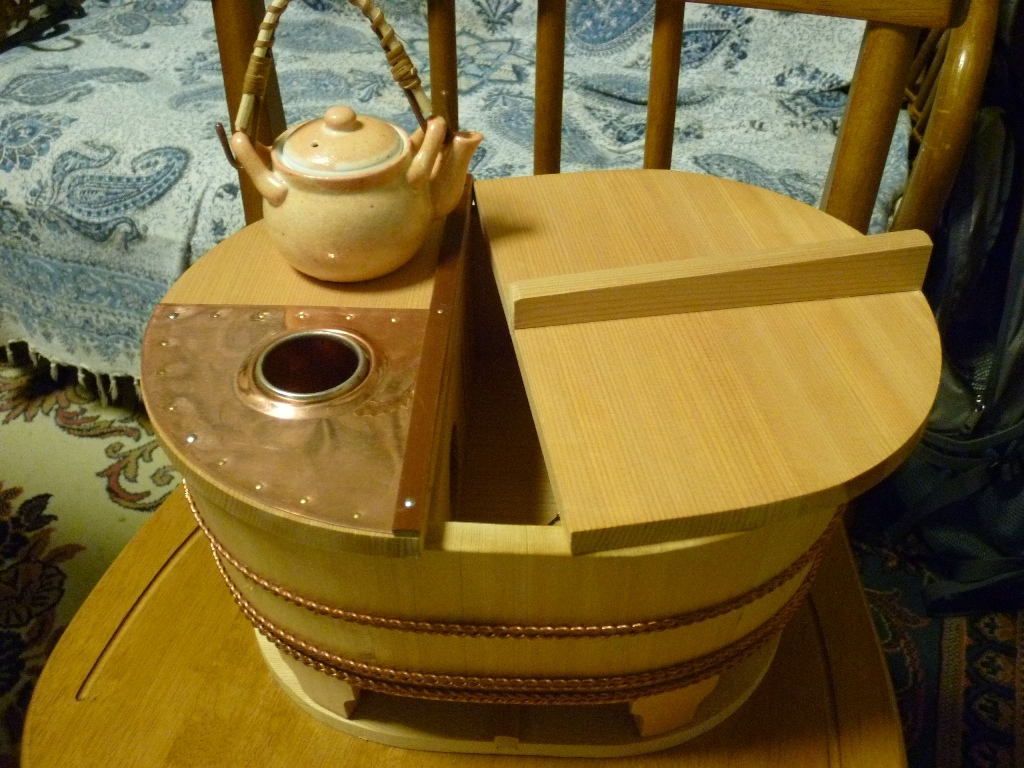
And, to make
the party more attractive, this time I introduced a new device for yudofu,
which is called yudofu-oke (wooden pail for making hot tofu). The pail
is made of sawara cypress and equipped with a brazier in which burning charcoal
is to be placed. When you put water in the pail and burning charcoal in the
brazier, the heat of the charcoal warms the water. So, you put cut tofu pieces in
the water to warm them up.
However, I
had some problems about the yudofu-oke. The opening of the brazier was
small and I can put only small pieces of charcoal in the brazier. Also, the
brazier itself is not very big to contain much charcoal. Maybe, yudofu should
not be eaten at so high a temperature, or I can preheat water with another pan
or kettle.
By the way, the
small pot with handle set on the yudofu-oke (see the picture below) is
for warming the sauce for yudofu. You just put some sauce in the pot and
set the pot on the yudofu-oke. However, if you love warmed sake, I think
you can put your sake in the pot and set it on the pail to warm it.
Well, what
about the matsutake sake? The sake was in a 1.8-litter bottle, and I had
some difficulty to take out the mushrooms. The mushrooms were first floating in
the upper part of the sake, but later they sank deep in the bottle. So we need
to empty the bottle first. We were five people, and some kindly brought 720-ml bottles
of sake. So, we had another three 720-ml bottles. After emptied these three
bottles, emptying another big bottle was hard for us. After all, I needed to
move some of the sake to an emptied small bottle.
The matsutake
sake has a slight smell of the matsutake mushrooms. The mushrooms, which
we grilled and ate, tasted alcoholic from being soaked in the sake for a long
time.
October 6,
the sake breweries of Maihime, Reijin, Honkin, Yokobue, and Masumi held a sake
drinking event called "Kamisuwa Kaido Aki no Nomiaruki" (autumn
sake-drinking walk along the Kamisuwa Kaido street). These five breweries are
located along Route 20, close to JR Kamisuwa Station.
Incidentally,
we were a six-people party and the five except me were women, with a high lady
rate of 83%. I don't have so many male acquaintances who love sake, and I think
I drink sake with women more often with men. As to my recent association, I
feel women drink sake more than men.
Well, I get
back to the original topic. Each of us first paid 2000 yen for a tag ticket and
a kikichoko, Hanging the ticket from the neck, we walked along the
street to visit the breweries. At each brewery, we could drink prepared sake as
much as we want using the given kikichoko. There were some food stands
from which we could buy some snacks to pair with sake.
We started walking
from the brewery closest to Kamisuwa Station, in the order of Maihime, Reijin,
and Honkin. Then, we skipped Yokobue (since the brewery was on the opposite
side of the street to the first three breweries) and went to Masumi. On the
return path toward the station, we visited the last brewery of Yokobue.
The
Miyama-nishiki version of Maihime Junmai Ginjo Suiro Namazazke (舞姫純米吟醸翠露生酒) had
a very mild taste, and I liked it. My companions liked the Bizen-omachi version
of this sake, but I feel my preference is leaning toward Miyama-nishiki.
At the Reijin
brewery's shop, they were selling special sake, Matsutake-zake (sake with mushrooms
loved by the Japanese in it) although this was not prepared for drinking in
this event. The bottle of this sake contains some Matsutake mushroom. I dropped
in this shop on my way home next day, and purchased a bottle of the sake. I
want to drink this sake warmed, while grilling the sake-steeped mushroom on
burning charcoal and eating it. The pairing of this sake and grilled mushroom
would be fine.
Over three
years ago, on May 19 of 2009, there was a sake event named "Nagano Sake
Messe in Tokyo"
at Grand Prince Hotel Akasaka, where I tasted Ikioi-Masamune (勢正宗) for the
first time.
At the booth
of Ikioi-Masamune, Mr. Takeya Kodama, a friend of mine, was helping the brewery
staff. He let me taste various types of Ikioi-Masamune including namazake
(non-pasteurized sake) and hiire sake (pasteurized sake) of the year, namazake
and hiire sake after one-year aging, futsushu (regular sake), and
30-year aged sake, and giving me detailed explanation of each sake. At that
time, I was impressed with its rich and bold taste.
Later, Mr.
Kodama started operation of his sake shop, Jizakeya Kodama, in Minami-otsuka,
Toshima-ku. He has frequently been holding sake parties inside Tokyo, and he usually calls brewers from
relevant breweries to attend such parties. I have been thinking of attending
such a party, but the venues were usually in Otsuka, Yotsuya, or Kanda, which
were a little far from my place, and I felt reluctant to attend such a party.
On August 7, he
held a sake party of Ikioi-Masamune at izakaya LP2 in Kichijoji. The
party was attended by Mr. Yasuhisa Seki, president of Maruse Syuzouten Brewery
and Mr. Shinji Seki from the brewery. I thought it was rare that Mr. Kodama
held his event in Kichijoji, and actually this was the first time for him to do
so. Kichijoji is not very far from my place (50 minutes by train), so I decided
to attend this party.
The attendees
of the party could enjoy various types of Ikioi-Masamune while listening to
interesting talks by President Seki and his son Shinji.
Friendly and
likable President Seki quite kindly answered our questions about his sake
making and related issues.
To make its
sake, Maruse Syuzouten uses the mochigome yodan shikomi method
(four-staged fermentation method using glutinous rice), which is a traditional
method, and the atsugake yodan shikomi method (four-staged fermentation
method using hot steamed glutinous rice), in which they add big balls of hot
steamed rice to the fermenting mash. The resultant sake, which is carefully
brewed through elaborate handwork, has a gentle sweet taste of glutinous rice.
According to
President Seki, they add big balls of hot steamed rice to the fermenting mash
at the final stage of the fermentation process of the atsugake yodan shikomi
method. As a result, the temperature of the mash is raised from approximately 8
degrees centigrade to approximately 12 degrees. Then, the enzymes and yeast
cells that have already almost stopped their activity are re-activated,
enhancing the taste of the sake. However, relying excessively on this method is
not recommended because it may generate acetic ether and the sake will often smell
like an overripe melon.
President
Seki seems to be sticking to sake making using glutinous rice. He said he would
like to use glutinous rice also for koji rice.
By the way, I
guessed that the sakekasu (sake-lees) obtained by pressing the
fermenting mash of this sake contained a lot of half-melted grains of glutinous
rice, and I asked President Seki whether it tastes nice. He said, "Yes,
and narazuke (pickles preserved in sake-lees) using this sakekasu
is especially nice."
At the party,
the following sakes are served in this order.
1. Daiginjo
2. Tokubetsu
Junmai Sake
3. Futsushu
Shiboritate Genshu
4. Atsugake
Yodan Junmai Nama Genshu
5. Atsugake
Yodan Junmai Hiire Genshu
6. One-year
aged Daiginjo
7. Two-year
aged Daiginjo
8. One-year
aged Atsugake Yodan Junmai Nama Genshu
All sakes had
elegant sweetness (I felt like the sweetness gently permeated cells of the body)
and a bold taste. Especially, Futsushu of No. 3 was very nice. It was so nice
that I could hardly believe that this was regular sake.
One-year aged
Atsugake Yodan Junmai Nama Genshu of No. 8 was also nice. This bottle had
personally been kept for a year by Mr. Kodama in the refrigerator at his shop,
and it is sold nowhere. This sake had a rich taste and bitterness, and it was
so nice that the inner side of my both cheeks wanted another mouthful after I
swallowed down a mouthful. It has a taste somewhat resembling a caramel sauce.
A little bitter but sweet.
After
drinking different types of Ikioi-Masamune, I thought that this sake tended to
become nicer after an aging period of one year or so. Maybe, sake is usually
gets better when it is aged for a proper period under proper conditions. I
sometimes try to keep my sake in the refrigerator, but however strongly I am
determined, I soon bow down to the lure of the sake and soon the bottle becomes
empty. This is my problem.
By the way,
the izakaya LP2, an underground restaurant, has a bright atmosphere. They
say that the interior design is based on the concept of sunlight filtering down
through the trees on a comfortable sunny day. On the ceiling and walls embedded
are a lot of sliced cedar logs resembling bracket fungi, diffusing the smell of
fresh timber. There are several counter seats and a few tables, and especially,
the tables are non-linear shaped tables, providing customers with a relaxing
mood so that they can feel like they are in a natural environment.
As to their
foods, each menu item was made elaborately and was nice.
Today's
video: My favorite kandouko sake warmer. I love warmed sake, and I use
this device to prepare warmed sake.


_458_258.png)
.png)
.png)