Recently, my friends and I visited Kyushu island (the southernmost one of the Japan's four major islands), stayed Nagasaki, Fukuoka, and Higashi-beppu, and spent one night in each city.
In Nagasaki city, we met members of the Nagasaki Kimono Study Circle and enjoyed the night of Nagasaki together. First, we visited a decent Japanese restaurant and enjoyed foods and some sake in a tatami-floored room in an elegant atmosphere. However, sake lovers from Tokyo as well as those in Nagasaki wanted more sake. So, we went out for some local sake to a drinking area.
This time, we appeared in Shianbashi Side Street, where many bars, restaurants and karaoke places are found.
My keen sense to locate places of good sake led us to a snug-looking izakaya, Sake Bar Ittanmomen. The name of this izakaya "Ittanmomen" is the name of a funny specter of the famous cartoon "Gegege no Kitaro." Wherever I am, I can locate whereabouts of good sake.
A cramped dark environment like the room in this video is very comfortable to me when drinking sake.
This time, I enjoyed the Nagasaki's local sake Rokujuyoshu Honjozo and Nokomi Junmai Ginjo of Saga prefecture.
Rokujuyoshu was sweetish with a dry aftertaste, exhibiting a quite characteristic taste. It seemed to be paired well with salty-sweet foods of Nagasaki.
Nokomi had mild and clean taste with a good ginjo aroma.


Oct 21, 2009
Shinto music and dance at Mitake Shrine
Located on the summit of Mt. Mitake in Ome city, Mitake Shrine has a long and venerable history. According to the Web site of this shrine, it was established in the 7th year of Emperor Sujin, which is indeed B.C. 91.
Emperor Sujin is the 10th Emperor and he appears in the Japanese myth Kojiki. So, the shrine was established as far back in the past as when main players of the myth were actually alive.
My friends and I visited this shrine to see takigi kagura (shinto music and dance performed under bonfires) on October 11.
Here, I present some photos taken during the performance.
(1) Urayasu-no-mai (dance praying for peace)
This number was performed by two junior high school girls. The dance and music are performed following lyrics composed by Emperor Showa. The lyrics say "I pray to the gods of the heavens and earth that the world may be peaceful like a calm sea in the morning that is not agitated."


(2) Hohei (offering of a sacred wooden stick to which paper strips hang down)
This dance is performed to purify the stage. The photo may not convey the atmosphere, but the performer danced a merry and rhythmical dance.


This performance represents a scene where a blade smith makes a celebrated sword with help from the god Inari (a god of harvests).


(4) Amano-iwato (rock door of the heavens)
This performance represents the legend describing how gods took out Amaterasu-ookami, who disappeared behind the rock door of the heavens. According to the Japanese myth Kojiki, since Uzumeno-mikoto goddess danced while baring her breast and slipping off her clothes down to expose her private parts, all the gods there broke into explosive laughter. Amaterasu-ookami opened the rock door slightly and watched out from curiosity. At this time, she was taken out of the door. Uzumeno-mikoto is probably the Japan's first nude dancer, but she stayed clad on the stage set up in front of the shrine.
Tajikaraono-mikoto, who is renowned for his unparalleled strong power, holds the rock door and throws it away in the photo on the right.

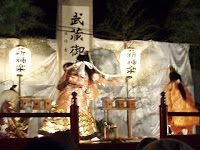
(5) Mountain god
This is the last number of this series of kagura performance. Kagura is dance and music to be dedicated to gods when food is offered to the gods. Rice cake is prepared as offering, and the performer of this performance throws the rice cake to spectators. So, we are given good luck from the gods.
I could collect seven pieces of rice cake. Since the rice cake is said to protect people from diseases and keep them sound, I brought it home and ate it with family. Thanks to the gods.

Mitake Shrine pavilions are on the summit of Mt Mitake, which stands 929 m above the sea level. Takigi kagura was performed in the open space in front of the torii gate that is located at a lower point than the shrine pavilions. Due to high elevation, it was cold at night in October. Even subtle warmness coming from the two bonfires placed on both sides of the stage along with the scent of soot was felt nice to me.
The dancers' clothes that emerged in the light of fire were sparkling as if they were corresponding to the flaring flames of the bonfires, drawing the audience into a world of illusion.
Today's Sake
Asazume-no-sake Sawanoi Honjizake (Ozawa Syuzou)
Ordinary Honjizake of Sawanoi except that it was bottled and pasteurized in the morning of October 1, the "Sake Day." When I bought this bottle in the evening, it was still slightly warm. I wanted the sake to stay warm until I brought it back home. So, I put the bottle inside my jacket and carried it. I could feel the subtle warmness of the sake and I felt my heart becoming warm.
Junmai sake with rich and bold taste.

Emperor Sujin is the 10th Emperor and he appears in the Japanese myth Kojiki. So, the shrine was established as far back in the past as when main players of the myth were actually alive.
My friends and I visited this shrine to see takigi kagura (shinto music and dance performed under bonfires) on October 11.
Here, I present some photos taken during the performance.
(1) Urayasu-no-mai (dance praying for peace)
This number was performed by two junior high school girls. The dance and music are performed following lyrics composed by Emperor Showa. The lyrics say "I pray to the gods of the heavens and earth that the world may be peaceful like a calm sea in the morning that is not agitated."


(2) Hohei (offering of a sacred wooden stick to which paper strips hang down)
This dance is performed to purify the stage. The photo may not convey the atmosphere, but the performer danced a merry and rhythmical dance.


This performance represents a scene where a blade smith makes a celebrated sword with help from the god Inari (a god of harvests).


(4) Amano-iwato (rock door of the heavens)
This performance represents the legend describing how gods took out Amaterasu-ookami, who disappeared behind the rock door of the heavens. According to the Japanese myth Kojiki, since Uzumeno-mikoto goddess danced while baring her breast and slipping off her clothes down to expose her private parts, all the gods there broke into explosive laughter. Amaterasu-ookami opened the rock door slightly and watched out from curiosity. At this time, she was taken out of the door. Uzumeno-mikoto is probably the Japan's first nude dancer, but she stayed clad on the stage set up in front of the shrine.
Tajikaraono-mikoto, who is renowned for his unparalleled strong power, holds the rock door and throws it away in the photo on the right.


(5) Mountain god
This is the last number of this series of kagura performance. Kagura is dance and music to be dedicated to gods when food is offered to the gods. Rice cake is prepared as offering, and the performer of this performance throws the rice cake to spectators. So, we are given good luck from the gods.
I could collect seven pieces of rice cake. Since the rice cake is said to protect people from diseases and keep them sound, I brought it home and ate it with family. Thanks to the gods.

Mitake Shrine pavilions are on the summit of Mt Mitake, which stands 929 m above the sea level. Takigi kagura was performed in the open space in front of the torii gate that is located at a lower point than the shrine pavilions. Due to high elevation, it was cold at night in October. Even subtle warmness coming from the two bonfires placed on both sides of the stage along with the scent of soot was felt nice to me.
The dancers' clothes that emerged in the light of fire were sparkling as if they were corresponding to the flaring flames of the bonfires, drawing the audience into a world of illusion.
Today's Sake
Asazume-no-sake Sawanoi Honjizake (Ozawa Syuzou)
Ordinary Honjizake of Sawanoi except that it was bottled and pasteurized in the morning of October 1, the "Sake Day." When I bought this bottle in the evening, it was still slightly warm. I wanted the sake to stay warm until I brought it back home. So, I put the bottle inside my jacket and carried it. I could feel the subtle warmness of the sake and I felt my heart becoming warm.
Junmai sake with rich and bold taste.
Seimaibuai: 65%
Alcohol: 15 - 16%
Sake meter value: -1
Acidity: 1.6

Oct 14, 2009
Nama Genshu and soda

The Stand-up BarSawanosuke was open at Sawanoien run by Ozawa Syuzou sake brewery limitedly on 10th and 11th of October.
By the way, my friend and I were to see takigi kagura (shinto music and dance performed under bonfire) at Mitake Shrine on October 11. And, Sawanoien is located near Sawai Station, which is one stop before Mitake Station, the station we were to get off the train. Then, what was the reason for passing Sawanoien without having some sips of sake there? Of course, we get off the train at Sawai Station.
Swanoien were attracting a lot of visitors as usual and there was a line of people in front of the kiosk where they were ordering soba noodle and other foods.
The Stand-up Bar Sawanosuke was selling "nama genshu and soda," non-pasteurized, non-diluted sake with carbonated water and ice. I tried one glass of it. A bit of citron juice had been added to this beverage. The flavor of citron mixed with briskness apparently deriving from live yeast was refreshing. With the addition of carbonated water, sake seemed to increase in its characteristic sweetness.
Before, I thought nama genshu should be drunk chilled without water or anything since I wanted to enjoy characteristic thick flavor of nama genshu. Now, I have changed my thought. Nama genshu and soda was actually nice.
(Nama genshu and soda priced at 350 yen)

(This is Sawabee, which has probably been created from the words "Sawanoi" and "beer.")

Oct 7, 2009
Study Tour to Tamura Syuzoujou Sake Brewery
Located in Fussa, a city in the far-flung west of Tokyo, Tamura Syuzoujou sake brewery has been making sake for nearly 190 years since its establishment in 1822. This time, my friends and I visited this brewery and saw facilities in this brewery to learn how they are making sake. Sales Manager, Mr. Hirahara, showed us their brewery. It was a fruitful study to receive explanation about sake making process while actually seeing samples of different sake rice varieties, sake making facilities, bubbling fermenting mash, etc.
After leaving the west exit of JR Fussa Station, go westward along the main street for about 10 minutes, and you will reach the intersection on Okutama Kaido street. Take the right here. Okutama Kaido street around here runs alongside Tamagawajosui Water Supply Channel. Walk toward the upper stream for a while to reach a pedestrian overpass, and you will find a small bridge over the channel. Walk across this bridge, and you will see a red brick chimney ahead on your left. Farther proceed on your way ahead, and you will be walking along the black wall long extending along the road. On the premises behind the wall, whitewashed buildings with massive tiled roofs stand orderly in a line. Huge trees stand high and extend boughs as if they were guarding these buildings, and you hear birds chirping. Now, you are in front of the main gate of Tamura Syuzoujou.


When we walked through the gate, we found a big cedar leaf ball hanging under the eaves of the building on your left. The ball was brownish, but it was soon to be replaced with a new green one when they would start the shipment of new brew. Placed on the right in front of the entrance of the building were three sake casks wrapped with rush mats with the brand name of "Kasen" on them.

When we walked under the cedar ball and went into the building, we found on the right the base of the red brick chimney that we had seen from a distance.
Having the shape of an octagonal column, this chimney was built in the middle of the Meiji period (1868-1912) and once damaged by the Great Kanto Earthquake. Later it was restored but it is not used currently. Mr. Hirahara said that, according to an architecture specialist, they should preserve this chimney even if they would not use it because the bricks used in this chimney were laid in a distinctive way.
On the opposite side of the chimney was a rice-steaming room. Before entering the room, we were shown samples of sake rice varieties. Rice grains that had been milled down and had become whiter were packed in plastic bags, on each of which the name of rice and rice milling rate are indicated on a label.
There were Yamadanishiki, Nihonbare, Ginginga, Miyamanishiki, and Yamasake No. 4. I have ever heard of Yamasake No. 4. If I remember right, this rice has been developed in an agricultural high school in Yamagata prefecture. Tamura Syuzoujou experimentally used this rice and succeeded in making quite good sake in the last season. So, they decided to use this rice in full-fledged production. Now, we can anticipate seeing a new type of sake from Tamura Syuzouhou on shelves in this season.
Well, we then moved to the rice-steaming room. Shiny stainless-steel rice soaking tanks, also shiny horizontal continuous rice steamer, rice cooling device, and other facilities were in the room. Beside the rice steamer was an old caldron for steaming rice that was not used currently.
Facilities of this brewery are relatively new and buildings are well constructed. We were shown fermentation tanks, which are hermetically sealed types and have the capacity of 10,000 litters for each. The upper floor from which they stir the mash with stirring rods are decently planked and looked to have been waxed. Such floors of old sake breweries are often humble and sometimes they creak when you walk on them. The floor of this brewery is steady and never creaks. The stirring rods, which are as long as five meters, are made of glass fiber.
In one of the fermentation tanks, ivory-white thick mash was bubbling. Enchanting sweet aroma like that of soda pop was rising up from the inside of the tank.
Although the facilities look latest or relatively new, the buildings in which these facilities are placed are old. The building in which fermentation tanks are placed was actually built in 1918. The roof of this building is tiled with hongawara (roof tiles usually used for shrines, temples, and other high-class architectures) and was built by miyadaiku (skillful carpenters specializing in shrine and temple buildings). This is a gorgeous building!
We were also shown the garden that is owned by the Tamura family. According to the book "Tokyo no Jizake" (Tokyo sake) written by Hiroyuki Koda. The Tamura family has a history of over 300 years, and family leaders were the headman of Fussa village. The garden is so old and a huge tree standing there is estimated to be as old as about 1,000 years. This tree is worth seeing. It is said that the boughs of the tree provided a good shade for brewery buildings in olden days keeping the building cool.
At the end of the study tour, we of course had sake sampling time happily. We tasted Tokubetu Honjozo Maboroshi-no-sake Kasen, Junmai Ginjo Namachozoshu, and a sample version of Junmai Ginjo Tamura. I specially liked Maboroshi-no-sake Kasen, which has richness and is modest in pomposity. According to Mr. Hirahara, a real sake lover tends to finally become to prefer honjoso type sake to ginjo type sake.
When we were walking inside the brewery, we saw the toji master brewer and other brewery workers working busily. As autumn gets far advanced toward winter now, new fermenting mash will be prepared one after another and they will get busier. I thank Mr. Hirahara for sparing time for us in this busy time.
After leaving the west exit of JR Fussa Station, go westward along the main street for about 10 minutes, and you will reach the intersection on Okutama Kaido street. Take the right here. Okutama Kaido street around here runs alongside Tamagawajosui Water Supply Channel. Walk toward the upper stream for a while to reach a pedestrian overpass, and you will find a small bridge over the channel. Walk across this bridge, and you will see a red brick chimney ahead on your left. Farther proceed on your way ahead, and you will be walking along the black wall long extending along the road. On the premises behind the wall, whitewashed buildings with massive tiled roofs stand orderly in a line. Huge trees stand high and extend boughs as if they were guarding these buildings, and you hear birds chirping. Now, you are in front of the main gate of Tamura Syuzoujou.


When we walked through the gate, we found a big cedar leaf ball hanging under the eaves of the building on your left. The ball was brownish, but it was soon to be replaced with a new green one when they would start the shipment of new brew. Placed on the right in front of the entrance of the building were three sake casks wrapped with rush mats with the brand name of "Kasen" on them.

When we walked under the cedar ball and went into the building, we found on the right the base of the red brick chimney that we had seen from a distance.
Having the shape of an octagonal column, this chimney was built in the middle of the Meiji period (1868-1912) and once damaged by the Great Kanto Earthquake. Later it was restored but it is not used currently. Mr. Hirahara said that, according to an architecture specialist, they should preserve this chimney even if they would not use it because the bricks used in this chimney were laid in a distinctive way.
On the opposite side of the chimney was a rice-steaming room. Before entering the room, we were shown samples of sake rice varieties. Rice grains that had been milled down and had become whiter were packed in plastic bags, on each of which the name of rice and rice milling rate are indicated on a label.
There were Yamadanishiki, Nihonbare, Ginginga, Miyamanishiki, and Yamasake No. 4. I have ever heard of Yamasake No. 4. If I remember right, this rice has been developed in an agricultural high school in Yamagata prefecture. Tamura Syuzoujou experimentally used this rice and succeeded in making quite good sake in the last season. So, they decided to use this rice in full-fledged production. Now, we can anticipate seeing a new type of sake from Tamura Syuzouhou on shelves in this season.
Well, we then moved to the rice-steaming room. Shiny stainless-steel rice soaking tanks, also shiny horizontal continuous rice steamer, rice cooling device, and other facilities were in the room. Beside the rice steamer was an old caldron for steaming rice that was not used currently.
Facilities of this brewery are relatively new and buildings are well constructed. We were shown fermentation tanks, which are hermetically sealed types and have the capacity of 10,000 litters for each. The upper floor from which they stir the mash with stirring rods are decently planked and looked to have been waxed. Such floors of old sake breweries are often humble and sometimes they creak when you walk on them. The floor of this brewery is steady and never creaks. The stirring rods, which are as long as five meters, are made of glass fiber.
In one of the fermentation tanks, ivory-white thick mash was bubbling. Enchanting sweet aroma like that of soda pop was rising up from the inside of the tank.
Although the facilities look latest or relatively new, the buildings in which these facilities are placed are old. The building in which fermentation tanks are placed was actually built in 1918. The roof of this building is tiled with hongawara (roof tiles usually used for shrines, temples, and other high-class architectures) and was built by miyadaiku (skillful carpenters specializing in shrine and temple buildings). This is a gorgeous building!
We were also shown the garden that is owned by the Tamura family. According to the book "Tokyo no Jizake" (Tokyo sake) written by Hiroyuki Koda. The Tamura family has a history of over 300 years, and family leaders were the headman of Fussa village. The garden is so old and a huge tree standing there is estimated to be as old as about 1,000 years. This tree is worth seeing. It is said that the boughs of the tree provided a good shade for brewery buildings in olden days keeping the building cool.
At the end of the study tour, we of course had sake sampling time happily. We tasted Tokubetu Honjozo Maboroshi-no-sake Kasen, Junmai Ginjo Namachozoshu, and a sample version of Junmai Ginjo Tamura. I specially liked Maboroshi-no-sake Kasen, which has richness and is modest in pomposity. According to Mr. Hirahara, a real sake lover tends to finally become to prefer honjoso type sake to ginjo type sake.
When we were walking inside the brewery, we saw the toji master brewer and other brewery workers working busily. As autumn gets far advanced toward winter now, new fermenting mash will be prepared one after another and they will get busier. I thank Mr. Hirahara for sparing time for us in this busy time.
Oct 1, 2009
Japanese Sake Day
When I compare two brands of sake one of which is namazake and the other is pasteurized sake, I prefer the former to the latter in most cases. I feel namazake and pasteurized sake are completely different products.
By the way, if one happens to come in an izakaya where they have only one type of sake and she or he orders it, the sake is, in many cases, inexpensive pasteurized sake such as futsushu (regular sake), I guess. I have no intention to say that futsushu is not good. However, I think it is difficult for many people to understand the virtue of futushu if they have not experienced many types of sake or they do not have a delicate palate.
So, if someone who has not drunk so much of sake before happening to drink such sake as futsushu at cheap izakaya, it is quite likely that she or he thinks "Maybe, I am not good at this."
However, when it comes to namazake, its refreshing fragrance and rich taste impresses you at the first moment when you take the very first sip. So, I would like those who believe they don't like sake to drink namazake as a trial. They may change their view on sake. If they judge sake to be not enjoyable after drinking only inexpensive futsushu, I feel chagrined.
I am thinking of the above lately. Anyway, today is the Japanese Sake Day. It seems that some breweries have started koji making and some have proceeded to fermentation process already. Liquor shops are selling akiagari (half-year aged sake) and hiayoroshi (half-year aged sake without pasteurization before shipment). Especially hiyaoroshi can be called half namazake since its pasteurization process before the shipment is skipped.
As autumn gets far advanced and it becomes cooler, it becomes easier to pass our days. We are blessed with delicious foods of autumn. Every food is really tasty in autumn. It may be the privilege of those who live in Japan to enjoy hiyaoroshi paired with nice foods in autumn.
Today's Sake
Kure Junmai Muroka Hiyaoroshi (Nishioka Sake Brewery)
Sake from Kochi prefecture. This hiyaoroshi has been aged in a cave in the headwaters area of the Shimanto River.
It has been aged to mellowness while maintaining the characteristic flavor of namazake. In spite of the sake meter value of +9, it is fresh rather than dry.

By the way, if one happens to come in an izakaya where they have only one type of sake and she or he orders it, the sake is, in many cases, inexpensive pasteurized sake such as futsushu (regular sake), I guess. I have no intention to say that futsushu is not good. However, I think it is difficult for many people to understand the virtue of futushu if they have not experienced many types of sake or they do not have a delicate palate.
So, if someone who has not drunk so much of sake before happening to drink such sake as futsushu at cheap izakaya, it is quite likely that she or he thinks "Maybe, I am not good at this."
However, when it comes to namazake, its refreshing fragrance and rich taste impresses you at the first moment when you take the very first sip. So, I would like those who believe they don't like sake to drink namazake as a trial. They may change their view on sake. If they judge sake to be not enjoyable after drinking only inexpensive futsushu, I feel chagrined.
I am thinking of the above lately. Anyway, today is the Japanese Sake Day. It seems that some breweries have started koji making and some have proceeded to fermentation process already. Liquor shops are selling akiagari (half-year aged sake) and hiayoroshi (half-year aged sake without pasteurization before shipment). Especially hiyaoroshi can be called half namazake since its pasteurization process before the shipment is skipped.
As autumn gets far advanced and it becomes cooler, it becomes easier to pass our days. We are blessed with delicious foods of autumn. Every food is really tasty in autumn. It may be the privilege of those who live in Japan to enjoy hiyaoroshi paired with nice foods in autumn.
Today's Sake
Kure Junmai Muroka Hiyaoroshi (Nishioka Sake Brewery)
Sake from Kochi prefecture. This hiyaoroshi has been aged in a cave in the headwaters area of the Shimanto River.
It has been aged to mellowness while maintaining the characteristic flavor of namazake. In spite of the sake meter value of +9, it is fresh rather than dry.
Rice used: Tosanishiki (sake rice harvested in Kochi prefecture)
Seimaibuai: 60%
Alcohol: 17 - 18%
Sake meter value: (+)9

Sep 30, 2009
Outdoor Sake
Located on the border between Yamanashi and Nagano prefectures and listed as a member of the 100 great mountains of Japan, Kimpu Mountain stands 2599 meters high above the sea level. My friends and I climbed this mountain last Sunday. It was an amazing mountain.


Unfortunately, after we started climbing, it became misty as we got close to the summit. We could not see Mt. Fuji, Southern Japan Alps, Yatsugatake, and other mountains, which were supposed to be in our view. Nevertheless, walking on the trail in the coniferous woods studded with deciduous trees such as birches was merry and comfortable. This was nice woods bathing. Due to the high elevation, the deciduous leaves had already begun to turn yellowish or reddish, contrasting well with the dark green of the conifers. In addition, the ground in the woods covered with moss was beautiful.


The summit is above the timberline and we saw many stunted pine trees in its vicinity. I guess we can see many types of alpine flowers in summer.


Today's Drunkard
I also drink sake even on a mountaintop!


Unfortunately, after we started climbing, it became misty as we got close to the summit. We could not see Mt. Fuji, Southern Japan Alps, Yatsugatake, and other mountains, which were supposed to be in our view. Nevertheless, walking on the trail in the coniferous woods studded with deciduous trees such as birches was merry and comfortable. This was nice woods bathing. Due to the high elevation, the deciduous leaves had already begun to turn yellowish or reddish, contrasting well with the dark green of the conifers. In addition, the ground in the woods covered with moss was beautiful.


The summit is above the timberline and we saw many stunted pine trees in its vicinity. I guess we can see many types of alpine flowers in summer.


Today's Drunkard
I also drink sake even on a mountaintop!
Sep 29, 2009
Does Material of Drinking Vessel Affect Taste?
I often hear that they discuss influence on the taste of sake by the shape of sake drinking vessels. So, I tasted the same sake with a wine glass and ordinary sake cup for comparison. I experienced difference in taste between the two different receptacles actually (see "Using a Wine Glass for Sake").
Then, what about the difference of material? Does the material of a drinking vessel affect the taste of sake? Let's see whether it does or not in an actual experiment.
This time, I used two cups that were somehow similar in shape but different in material. One was an earthenware cup, and the other, a porcelain cup. The earthenware cup was glazed only partly and looked porous in most parts, so I guessed it absorbs sake in itself. Minerals or some components contained in the material may affect the taste. The porcelain cup is a small sake tasting cup with indigo color circles in it.


Frankly, I couldn't discern the difference in taste or aroma.
This time, I drank the sake soon after I poured it into the cups. Maybe, waiting for drinking for a while may cause change in taste or aroma. Also, if I had drunk it at a room temperature, I might have been able to discern subtle difference in flavor. So, next time, I will pour some sake into these two cups and leave them for half a day at a room temperature.

Today's Sake
Junmai Ginjo Yamahai Hiyaoroshi Yamazaru Muroka Genshu (Nagayama Shuzo)
This sake does not exhibit the characteristic flavor of yamahai sake very much. However, it has richness resulting from its aging and its acid and roughness that remind me some type of fruit such as an apricot are refreshing.

Then, what about the difference of material? Does the material of a drinking vessel affect the taste of sake? Let's see whether it does or not in an actual experiment.
This time, I used two cups that were somehow similar in shape but different in material. One was an earthenware cup, and the other, a porcelain cup. The earthenware cup was glazed only partly and looked porous in most parts, so I guessed it absorbs sake in itself. Minerals or some components contained in the material may affect the taste. The porcelain cup is a small sake tasting cup with indigo color circles in it.


Frankly, I couldn't discern the difference in taste or aroma.
This time, I drank the sake soon after I poured it into the cups. Maybe, waiting for drinking for a while may cause change in taste or aroma. Also, if I had drunk it at a room temperature, I might have been able to discern subtle difference in flavor. So, next time, I will pour some sake into these two cups and leave them for half a day at a room temperature.

Today's Sake
Junmai Ginjo Yamahai Hiyaoroshi Yamazaru Muroka Genshu (Nagayama Shuzo)
This sake does not exhibit the characteristic flavor of yamahai sake very much. However, it has richness resulting from its aging and its acid and roughness that remind me some type of fruit such as an apricot are refreshing.
Rice used: Yamadanishiki
Seimaibuai: 60%
Alcohol: 18 - 19%

Subscribe to:
Posts (Atom)