Recently, I checked old video data I took before, and found footage of kagami-biraki (ceremonial way making a toast with sake). Since I thought this can be a good movie, I edited the data and uploaded it to the Youtube site.
The movie I presents in this post was taken when we had a Christmas party for kimono lovers in 2008. A generous sales person from OZEKI Co. Ltd. (famous and big sake brewery in Japan) kindly prepared a big cask of sake for us, and we could have this wonderful experience.
The Japanese often celebrate happy events with kagami-biraki. In kagami-biraki, a wooden cask filled with sake is prepared. People crack open this cask and then make a toast with the sake.
A cask for kagami-biraki is usually filled with inexpensive regular sake, and regular sake is in many cases light and quaffable. Actually, I do not easily become tired of drinking regular sake. So, although I usually like rich and bold sake like muroka nama genshu or full-bodied sake such as yamahai, I sometimes feel inclined to drink regular sake.
Since the cask is made of cedar, the sake takes scent of cedar in the cask. Magic of cedar scent turns the cheap sake into something completely different.
Regular sake drunk as casked sake is fresh, flinty, and crispy, and gives you briskness. This is due to the scent of cedar that the sake takes while it is prepared in the cask.
Oh, after watching my video, I became to deliriously crave casked sake.
Sep 30, 2010


Sep 24, 2010
No 720-ml bottle, but a 1800-ml bottle
If you visit a liquor shop in Japan, you will find various sake bottles being sold there. And if you a great sake lover, you may want to buy as many bottles as possible so as to try as many types of sake as possible. In my case, I usually prefer 720-ml bottles to 1800-ml bottle to buy because smaller bottles allow you to buy many types of sake at lower cost and you don't need to continue to drink very much of the sake of one bottle before moving on to another bottle.
On the premises of Ishikawa Brewery, which is making Tamajiman sake, the company is operating the sake shop "Sake Cellar" (酒世羅). I often see bottles of Junmai Ginjo Muroka Nama Genshu "Koryu" (紅龍) are displayed on a shelf in the refrigerator at the shop. And every time I see these bottles, I want to buy one, but this sake is sold only in 1800-ml bottles. So, I have been somewhat hesitant about buying the sake.

This summer, I found this sake was served in an izakaya in Tachikawa city, so I ordered a glass of this sake. This sake gave me a bold impression and I liked it.
So, recently I drove my car to the brewery and bought a 1800-ml bottle of this sake at the sake shop there. I had probably been thinking of this sake for more than a year, and finally I bought it.
Having been made from 50% polished Gohyakumangoku sake rice, this junmai ginjo sake was sweetish with a clear taste. Although I felt the sake was still young in its taste, I expect time will add to the good taste.
On the premises of Ishikawa Brewery, which is making Tamajiman sake, the company is operating the sake shop "Sake Cellar" (酒世羅). I often see bottles of Junmai Ginjo Muroka Nama Genshu "Koryu" (紅龍) are displayed on a shelf in the refrigerator at the shop. And every time I see these bottles, I want to buy one, but this sake is sold only in 1800-ml bottles. So, I have been somewhat hesitant about buying the sake.

This summer, I found this sake was served in an izakaya in Tachikawa city, so I ordered a glass of this sake. This sake gave me a bold impression and I liked it.
So, recently I drove my car to the brewery and bought a 1800-ml bottle of this sake at the sake shop there. I had probably been thinking of this sake for more than a year, and finally I bought it.
Having been made from 50% polished Gohyakumangoku sake rice, this junmai ginjo sake was sweetish with a clear taste. Although I felt the sake was still young in its taste, I expect time will add to the good taste.
Sep 9, 2010
Season of Hiyaoroshi
Hiyaoroshi or namazumeshu is a certain type of sake. Usually, sake is pasteurized twice before it is shipped. The first pasteurization of sake is performed after the sake is pressed and before it enters the aging process, and then the second pasteurization comes when the sake is bottled. However, for hiyaoroshi sake, the second pasteurization process never occurs, it is shipped after the aging period of half a year or so without undergoing the second-time pasteurization. Thus, hiyaoroshi sake acquires mellowness through the aging process while maintaining a flavor of namazake.
Around September 5, I received a notice informing of hiyaoroshi sake being sold or to be sold soon from the liquor shop where I often buy sake. A flier I received showed hiyaoroshi sake from breweries in the Nishitama area. According to flier, Sawanoi, Kasen, and Chiyozuru are shipping hiyaoroshi, while Tamajiman is selling Daiginjo Muroka Genshu Aki no Yorokobi.
This summer saw excruciatingly sizzling days but autumn is steadily approaching; cicadas are no longer chirp, while autumn grasshoppers and crickets are getting louder. Hiyaoroshi is the sake that tells you the coming of autumn. I made a phone call to this liquor shop and ordered some bottles of hiyaoroshi.

At another liquor shop, they are also selling hiyaoroshi sake that comes from various places in Japan. In the refrigerator of the shop are Ichinokura, Urakasumi, Mine-no-Hakubai, Harushika, etc. I bought Harushika Junmai Ginjo Namazume and Kamikokoro Umakuchi Hiyaoroshi at this shop.

I had a try of Harushika first. Gulp, gulp, .... It was very nice sake. Hiyaoroshi is a taste of autumn.
Within a few days, the liquor to which I called will deliver the hiyaoroshi bottles I ordered. As it will become cooler and sake will become tastier.
Around September 5, I received a notice informing of hiyaoroshi sake being sold or to be sold soon from the liquor shop where I often buy sake. A flier I received showed hiyaoroshi sake from breweries in the Nishitama area. According to flier, Sawanoi, Kasen, and Chiyozuru are shipping hiyaoroshi, while Tamajiman is selling Daiginjo Muroka Genshu Aki no Yorokobi.
This summer saw excruciatingly sizzling days but autumn is steadily approaching; cicadas are no longer chirp, while autumn grasshoppers and crickets are getting louder. Hiyaoroshi is the sake that tells you the coming of autumn. I made a phone call to this liquor shop and ordered some bottles of hiyaoroshi.

At another liquor shop, they are also selling hiyaoroshi sake that comes from various places in Japan. In the refrigerator of the shop are Ichinokura, Urakasumi, Mine-no-Hakubai, Harushika, etc. I bought Harushika Junmai Ginjo Namazume and Kamikokoro Umakuchi Hiyaoroshi at this shop.

I had a try of Harushika first. Gulp, gulp, .... It was very nice sake. Hiyaoroshi is a taste of autumn.
Within a few days, the liquor to which I called will deliver the hiyaoroshi bottles I ordered. As it will become cooler and sake will become tastier.
Sep 7, 2010
Vinegared Rice with Okutama Yamame (Mountain Trout)
The Japanese food restaurant named "Imoutoya" stands on the Tama River, on the side opposite to JR Mitake Station on Ome Line.

"Okutama Yamame no Chirashizushi" they serve at this restaurant includes sliced raw yamame (mountain trout), but this yamame, (Okutama Yamame) is not of an ordinary type.
According to the Web site of Okutama Fish Breeding Center of Tokyo, Okutama Yamame is "triploid female yamame that has been bred by using biotechnology. This fish never reaches maturity and grows over 2 Kg in weight in three years. It is well suited for cuisine such as sashimi and meunière, which are usually made using meat of rather a big fish." In other words, these fish do not spawn, and they grow larger and taste better than common yamame.
Recently, I ordered Okutama Yamame no Chirashizushi at this restaurant for lunch.

The fish meat is different from common yamame in appearance, looking somewhat pinkish like salmon.

Topped with young Welsh onion, green shiso, myoga, and other herbs, firm sliced raw fish tasted nice.
And sake! They serve Sawanoi sake tasting set "Ki-Sho-Ten-Ketsu (起承転結)" including four different types of sake.

Ki 起: Junmai Namazake Sawane. Fresh sake with low alcohol and slightly higher acidity
Sho 承: Honjozo Nama. Sake with a typical taste. Moderate alcohol gives this sake a flinty impression.
Ten 転: Soten, junmai ginjo sake, with rich body.
Ketsu 結: Daiginjo. Nice aroma and flinty taste.

"Okutama Yamame no Chirashizushi" they serve at this restaurant includes sliced raw yamame (mountain trout), but this yamame, (Okutama Yamame) is not of an ordinary type.
According to the Web site of Okutama Fish Breeding Center of Tokyo, Okutama Yamame is "triploid female yamame that has been bred by using biotechnology. This fish never reaches maturity and grows over 2 Kg in weight in three years. It is well suited for cuisine such as sashimi and meunière, which are usually made using meat of rather a big fish." In other words, these fish do not spawn, and they grow larger and taste better than common yamame.
Recently, I ordered Okutama Yamame no Chirashizushi at this restaurant for lunch.

The fish meat is different from common yamame in appearance, looking somewhat pinkish like salmon.

Topped with young Welsh onion, green shiso, myoga, and other herbs, firm sliced raw fish tasted nice.
And sake! They serve Sawanoi sake tasting set "Ki-Sho-Ten-Ketsu (起承転結)" including four different types of sake.

Ki 起: Junmai Namazake Sawane. Fresh sake with low alcohol and slightly higher acidity
Sho 承: Honjozo Nama. Sake with a typical taste. Moderate alcohol gives this sake a flinty impression.
Ten 転: Soten, junmai ginjo sake, with rich body.
Ketsu 結: Daiginjo. Nice aroma and flinty taste.
Aug 31, 2010
Drinking Kisho while eating sumibiyaki charcoal-grilled foods
Sake can be paired with various types of foods, but if you want to enjoy this beverage in quite a Japanese atmosphere, you can of course go to a Japanese restaurant.

In a walking distance from Nozaki Syuzou, the brewery that is making Kisho, in Akiruno City, Tokyo, there is a Japanese restaurant named "Kurochaya." This restaurant serves sumibiyaki charcoal-grilled foods. The over 250-year-old buildings of this restaurant were before owned by a big sericulturist who was a village headman in the vicinity, and the buildings have been brought over from the original place and reassembled here.
When you enter the front gate while seeing a big water mill wheel on your left, you get in the garden of the restaurant that looks like a grove where restaurant houses with thatched roofs and magnificent structure stand. The garden is interspersed with bamboo and other trees, resting arbors, souvenir shops, etc. This place is on a cliff from which you can look down on the Akigawa River. I could see from a resting bench children bathing in a clear stream and an angler fishing sweetfish.
Inside the restaurant, beams, columns, and floors were shining black, and tools for reeling silk off cocoons including spinning wheels, tools for making medicine, and other antiques were displayed. Baskets that had been used for sericultural work were hanging upside down from the ceiling. These baskets on which paper was pasted were now used as lamp shades.
Sake we enjoyed at this restaurant while waiting for fish, meat, and vegetables to be cooked on the grill was of course Kisho. Namazake served in bamboo tubes was of course very nice. However, I wanted to drink sake in a relaxing mood with the nice foods, and in that case, I prefer nurukan or lukewarm sake. Anyway, if you are Kisho fan, this is a perfect place for you.

In a walking distance from Nozaki Syuzou, the brewery that is making Kisho, in Akiruno City, Tokyo, there is a Japanese restaurant named "Kurochaya." This restaurant serves sumibiyaki charcoal-grilled foods. The over 250-year-old buildings of this restaurant were before owned by a big sericulturist who was a village headman in the vicinity, and the buildings have been brought over from the original place and reassembled here.
When you enter the front gate while seeing a big water mill wheel on your left, you get in the garden of the restaurant that looks like a grove where restaurant houses with thatched roofs and magnificent structure stand. The garden is interspersed with bamboo and other trees, resting arbors, souvenir shops, etc. This place is on a cliff from which you can look down on the Akigawa River. I could see from a resting bench children bathing in a clear stream and an angler fishing sweetfish.
Inside the restaurant, beams, columns, and floors were shining black, and tools for reeling silk off cocoons including spinning wheels, tools for making medicine, and other antiques were displayed. Baskets that had been used for sericultural work were hanging upside down from the ceiling. These baskets on which paper was pasted were now used as lamp shades.
Sake we enjoyed at this restaurant while waiting for fish, meat, and vegetables to be cooked on the grill was of course Kisho. Namazake served in bamboo tubes was of course very nice. However, I wanted to drink sake in a relaxing mood with the nice foods, and in that case, I prefer nurukan or lukewarm sake. Anyway, if you are Kisho fan, this is a perfect place for you.
Aug 26, 2010
Sake I drunk in Nasu
Lately, we have sizzling days in July and August here in Japan. It is too bad that some people died from the heat of summer.
To escape from the brazing inferno, I planned a short trip to the Nasu highlands. My friends and I gathered and left to the destination place in two cars last Saturday.
Nasu is a highland place in the north of Tochigi Prefecture. Naturally, it is cooler than our places. There, we had an overnight stay in a small rental cottage.
Beside the cottage, a small mountain stream was running, and the bathhouse that only the lodgers of our cottage can use stood on the river bank. In the bathhouse, a hot spring bath was provided. I first bathed in the stream to cool down myself then I warmed in the hot bath. It was a very relaxing experience.
Another amusement was barbecue. We had bought meet and vegetables to cook at a nearby grocery store before we got to the cottage.

And, as to beverages, beer, shochu, and whiskey were on the table, and of course sake.
One of our members was actually a sake master brewer from a brewery in Tokyo. He kindly brought to the cottage a premium daiginjo sake he made and another commercially available bottle of Yatsushika.

The daiginjo sake was nice but might be too nice for our wild BBQ food, while Yatsushika's bold impression and nice aroma of mellowness were well paired the BBQ foods. The master brewer (the guy behind the bottle in the photo above) was quite happy especially with this sake.
Another lady brought a 1800-ml bottle of Junmai Daiginjo Kinshi Masamune Matsuya Kyubei. She was bought this sake in Kyoto because she liked this bottle. Finally she brought this bottle in the bathhouse and later we joined her for enjoying mixed bathing with this expensive sake.

I myself brought a small bottle of Junmai Goyotei from Shiraso Co. Ltd. This sake tasted quite like a namazake. I liked this one but the master brewer didn't appear to.

To escape from the brazing inferno, I planned a short trip to the Nasu highlands. My friends and I gathered and left to the destination place in two cars last Saturday.
Nasu is a highland place in the north of Tochigi Prefecture. Naturally, it is cooler than our places. There, we had an overnight stay in a small rental cottage.
Beside the cottage, a small mountain stream was running, and the bathhouse that only the lodgers of our cottage can use stood on the river bank. In the bathhouse, a hot spring bath was provided. I first bathed in the stream to cool down myself then I warmed in the hot bath. It was a very relaxing experience.
Another amusement was barbecue. We had bought meet and vegetables to cook at a nearby grocery store before we got to the cottage.

And, as to beverages, beer, shochu, and whiskey were on the table, and of course sake.
One of our members was actually a sake master brewer from a brewery in Tokyo. He kindly brought to the cottage a premium daiginjo sake he made and another commercially available bottle of Yatsushika.

The daiginjo sake was nice but might be too nice for our wild BBQ food, while Yatsushika's bold impression and nice aroma of mellowness were well paired the BBQ foods. The master brewer (the guy behind the bottle in the photo above) was quite happy especially with this sake.
Another lady brought a 1800-ml bottle of Junmai Daiginjo Kinshi Masamune Matsuya Kyubei. She was bought this sake in Kyoto because she liked this bottle. Finally she brought this bottle in the bathhouse and later we joined her for enjoying mixed bathing with this expensive sake.

I myself brought a small bottle of Junmai Goyotei from Shiraso Co. Ltd. This sake tasted quite like a namazake. I liked this one but the master brewer didn't appear to.

Aug 16, 2010
Tofu restaurant "Ukai"
The garden was maintained quite well. Carp were seen in the pond in the center of the garden. I felt the space was a little small and the atmosphere was damp, but the setting here was relaxing and appeared suitable for killing time to wait for companions to have lunch with; stone-paved paths in the garden were wet with sprinkled water; a wind-bell under the eaves was swaying in the breeze and sounding clearly and brightly; thus, the entire stage scenery here seemed helpful in adding to the cool and refreshing taste of the garden. This place I was visited recently was the tofu food restaurant "Ukai" in Hachioji City.
In the garden, there was the spring water that was used to make tofu of this restaurant. I had a mouthful of the water, which tasted mild and permeated through my body.
On this day, this tasteful and elegant restaurant was used as the venue of a luncheon party of our kimono circle. Since most of members of the circle are women, it is virtually a must for me to attend this gathering (maybe, I'm a philogynist).
We had some sake in a friendly and relaxing mood while enjoying foods beautifully arranged on small plates and bowl saucers. This was a delight of the palate and sight.
Sake Note
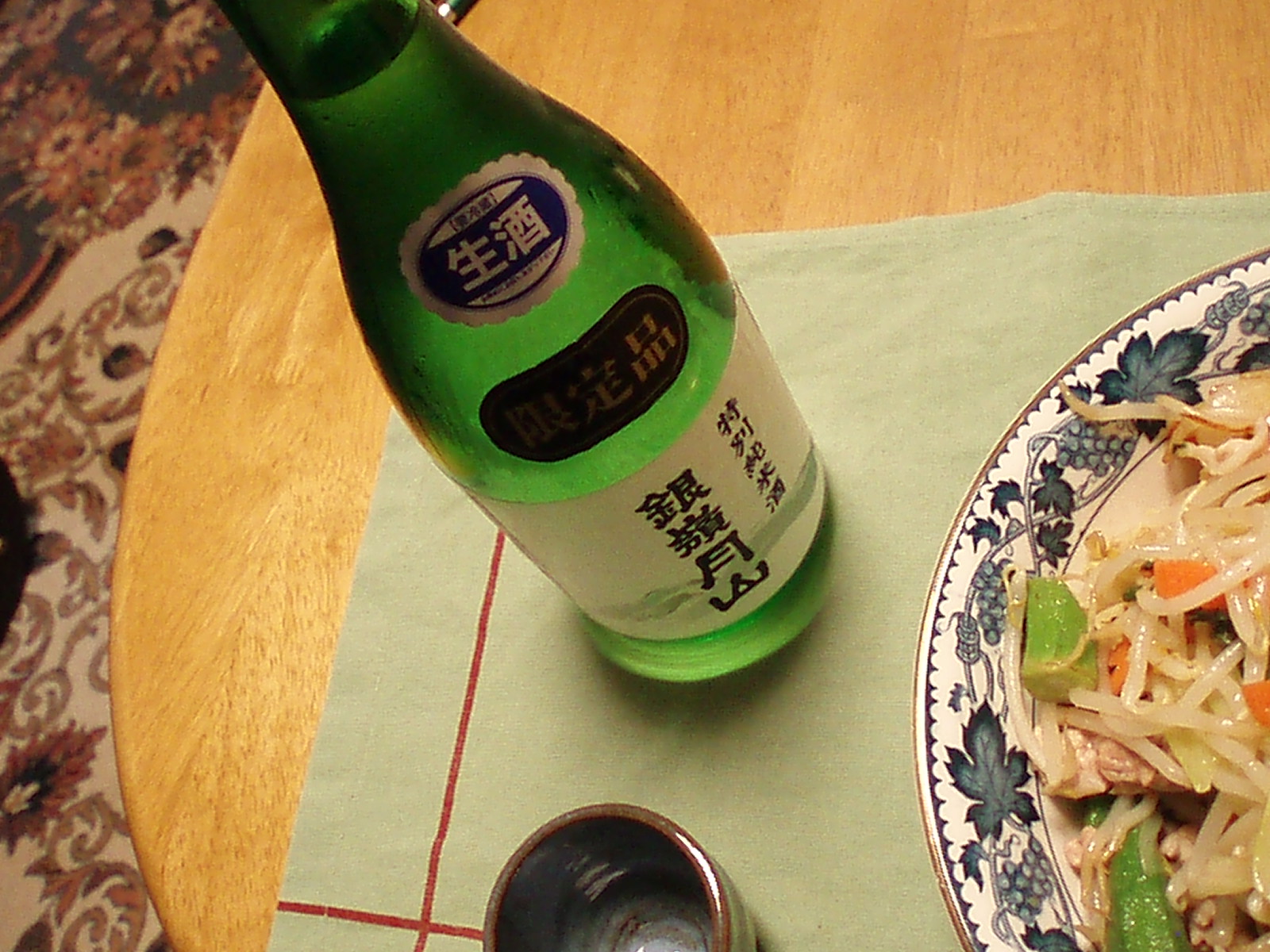
Tokubetsu Junmai Ginrei Gassan Nama (特別純米 銀嶺月山 生)
"Gassan" is the name of a mountain in the Tohoku area. The mountain is know for its behind-the-season skiing (the skiing season is from late spring to early summer) and also known as an object of mountain worship. Having the same name, this name sounds conveying cool air from the mountain. Is this too easy of me to think in this way?
The impression of the sake was that of average namasake but it has rather a higher degree of boldness in various aspects: bouquet, taste, etc. The alcohol content is 16 to 17, also being higher than typical sake. However, it leaves a clean-cut aftertaste.

In the garden, there was the spring water that was used to make tofu of this restaurant. I had a mouthful of the water, which tasted mild and permeated through my body.
On this day, this tasteful and elegant restaurant was used as the venue of a luncheon party of our kimono circle. Since most of members of the circle are women, it is virtually a must for me to attend this gathering (maybe, I'm a philogynist).
We had some sake in a friendly and relaxing mood while enjoying foods beautifully arranged on small plates and bowl saucers. This was a delight of the palate and sight.
Sake Note
Tokubetsu Junmai Ginrei Gassan Nama (特別純米 銀嶺月山 生)
"Gassan" is the name of a mountain in the Tohoku area. The mountain is know for its behind-the-season skiing (the skiing season is from late spring to early summer) and also known as an object of mountain worship. Having the same name, this name sounds conveying cool air from the mountain. Is this too easy of me to think in this way?
The impression of the sake was that of average namasake but it has rather a higher degree of boldness in various aspects: bouquet, taste, etc. The alcohol content is 16 to 17, also being higher than typical sake. However, it leaves a clean-cut aftertaste.
Subscribe to:
Posts (Atom)